

01 /
The Resin Code Answers the Easy Question
The complete product may have other plans
For reusable packaging, industrial containers, and durable consumer products, the resin is only the beginning. Labels, adhesives, coatings, and identity technologies can change the answer.
Both are widely recognized, highly adaptable polyolefins capable of supporting durable products and circular material systems. But recyclable plastic does not automatically create a recyclable finished product.
Then come the labels. Adhesives. Coatings. Inks. RFID tags. Metal components. Perhaps three technologies performing jobs no one considered together.
The resin may be ready for its next life. The complete product may have other plans.

A resin identification code describes the base plastic. It does not certify that the finished product can be collected, sorted, processed, and returned to productive use. ASTM makes that distinction explicit: a resin code does not mean an article is recycled, or that a system exists to recycle it.
It identifies the material. It does not absolve the design.
02 /
Regulation Is Beginning To Notice the Difference
Moving from an ingredient claim to a systems question
Extended Producer Responsibility initially focuses on single-use packaging because that is where the volume, visibility, and political energy live.
But the design logic will not remain there.
Europe’s Packaging and Packaging Waste Regulation evaluates recyclability through the complete packaging construction, including its individual components and compatibility with established collection, sorting, and recycling processes. In the United States, the Association of Plastic Recyclers also evaluates labels, inks, adhesives, closures, and other design features, not merely the container resin.
The direction is becoming clear: recyclability is moving from an ingredient claim to a systems question.
For reusable packaging and durable plastic products, there is still time to design intelligently. That does not make the issue less relevant. It makes the opportunity larger.
03 /
Identity Has Become Part of the Infrastructure
Following industrial assets for years
A logo once had a fairly relaxed job. Look respectable. Survive shipping. Avoid peeling off before the customer pays the invoice.
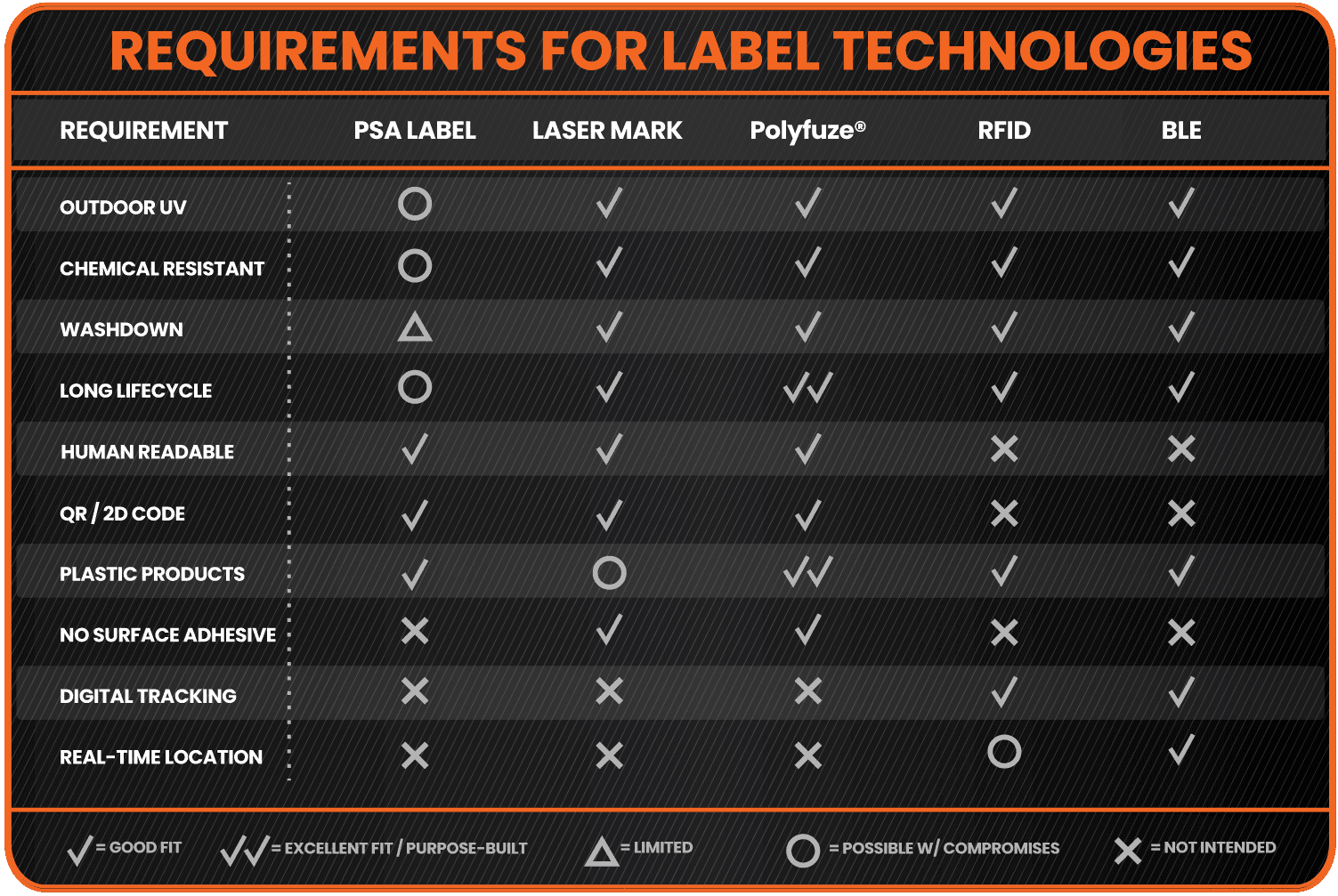
Today, identity may carry a serial number, safety warning, operating instructions, barcode, QR code, or digital product record. Track-and-trace technology has become dramatically less expensive, allowing identity to follow industrial assets across years of use, repeated handling, washdowns, recovery, and recirculation.
The graphic is no longer decoration. It is infrastructure.
And infrastructure that disappears halfway through the product’s life is not particularly impressive infrastructure.

04 /
Permanent Is Not the Same as Compatible
Recycling compatibility is separate
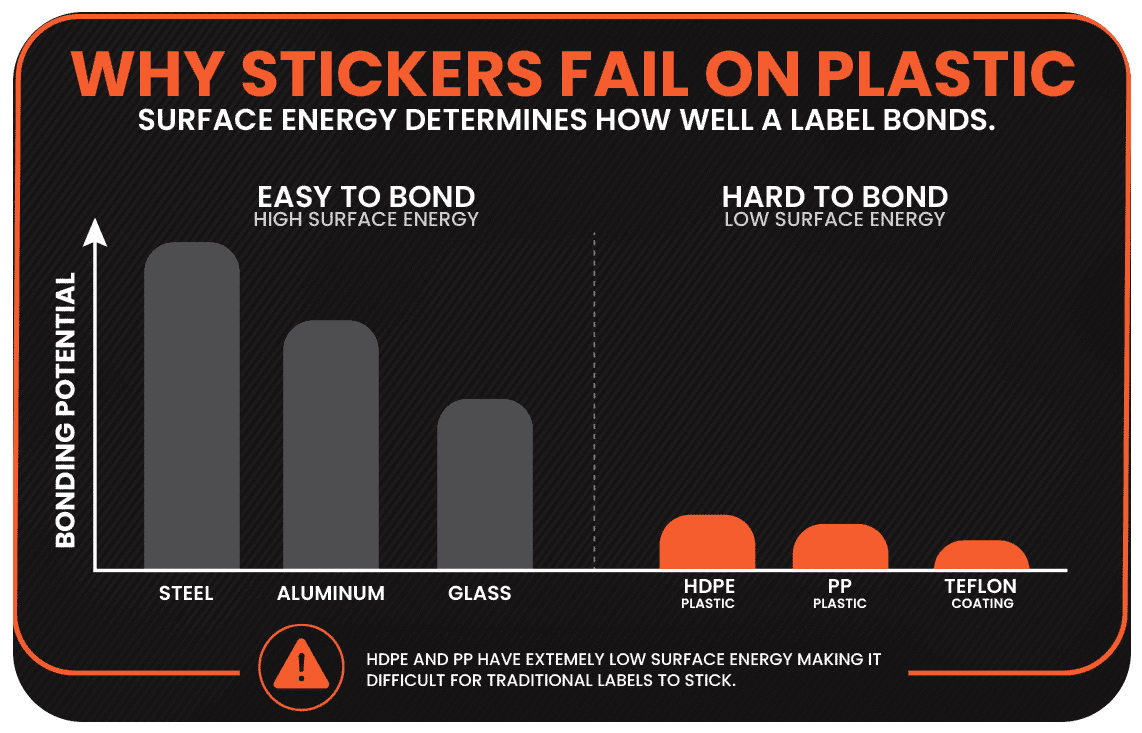
Most conventional labels depend on adhesion. That creates a difficult assignment on polyethylene and polypropylene, which have some of the lowest surface-energy levels among common industrial materials.
Surface treatments and aggressive adhesives can improve initial attachment. But initial attachment is not lifecycle permanence. UV exposure, abrasion, chemicals, moisture, temperature cycling, repeated washing, and material expansion continue long after the adhesion test ends.
Recycling compatibility is a separate question.
A label may remain permanently attached while introducing a different substrate, adhesive, coating, or functional component into the recycling stream. Another graphic may be technically recyclable on its own but incompatible with the product to which it is attached.
“Polymer-based,” “permanent,” “recyclable,” and “mono-material” are not interchangeable conclusions. Each requires its own evidence.
05 /
Evaluate the Complete Identity System
Ask these four questions
Evaluate the Complete Identity System
Manufacturers of reusable and durable plastic products should ask four questions:
What materials are present in the finished construction?
Will the identity remain functional throughout the intended product life?
Is the complete construction compatible with a defined recycling stream?
What testing supports each claim?
Polyfuze takes a different approach to product identity. Compatible polyolefin graphics are integrated into polyolefin plastics using controlled heat and pressure. Instead of attaching a separate label system to the surface, the identity becomes part of the material structure itself.
The future of durable plastic will not be determined by who says “permanent,” “recyclable,” or “mono-material” most often.
It will be determined by who can prove it across the complete product lifecycle.
