
WHY POLYFUZE WORKS
No adhesives. No delamination. No surface failure.
SUSTAINABILITY
SUSTAINABILITY STARTS LONG BEFORE RECYCLING
THE HIDDEN WASTE OF DISPOSABLE IDENTITY
A product that remains useful for twenty years creates less environmental impact than one that requires repeated replacement, maintenance, or rework. Durability is one of the most important sustainability decisions made during product design. Most labels are designed as consumables. They fade. Peel. Detach. Require replacement. Each replacement creates additional material consumption, labor, transportation, inventory, and waste.
These impacts rarely appear in sustainability reports, but they are part of the product’s environmental footprint.

CIRCULARITY
CIRCULAR SYSTEMS DEPEND ON DURABLE IDENTITY
CIRCULARITY IS NOT SIMPLY ABOUT RECYCLING.
It is about keeping products and materials in use for as long as possible. Reusable packaging, medical devices, industrial assets, consumer products, and durable goods all rely on durable identification to remain operational. Without durable identity, assets become difficult to track, recover, maintain, and reuse.
MONO-MATERIAL SYSTEMS SIMPLIFY RECOVERY
Polyfuze creates a mono-material structure by integrating compatible identity materials directly into the product itself. The result is a cleaner material stream and a simpler path toward reuse and recycling.

1. MANUFACTURE
Identity is fused into the material.
2. USE & TRACK
Durable identity enables tracking, maintenance, and long-term use.
3. RECOVER & REUSE
Assets are easily identified and returned to service.
4. RECYCLE
Mono-material stream is clean and simple to recycle.
5. NEW PRODUCT
Material is cycled back into new products, closing the loop.
TRADITIONAL LABEL JOURNEY
Traditional labels introduce secondary materials, adhesives, films, and layers that complicate recovery processes.
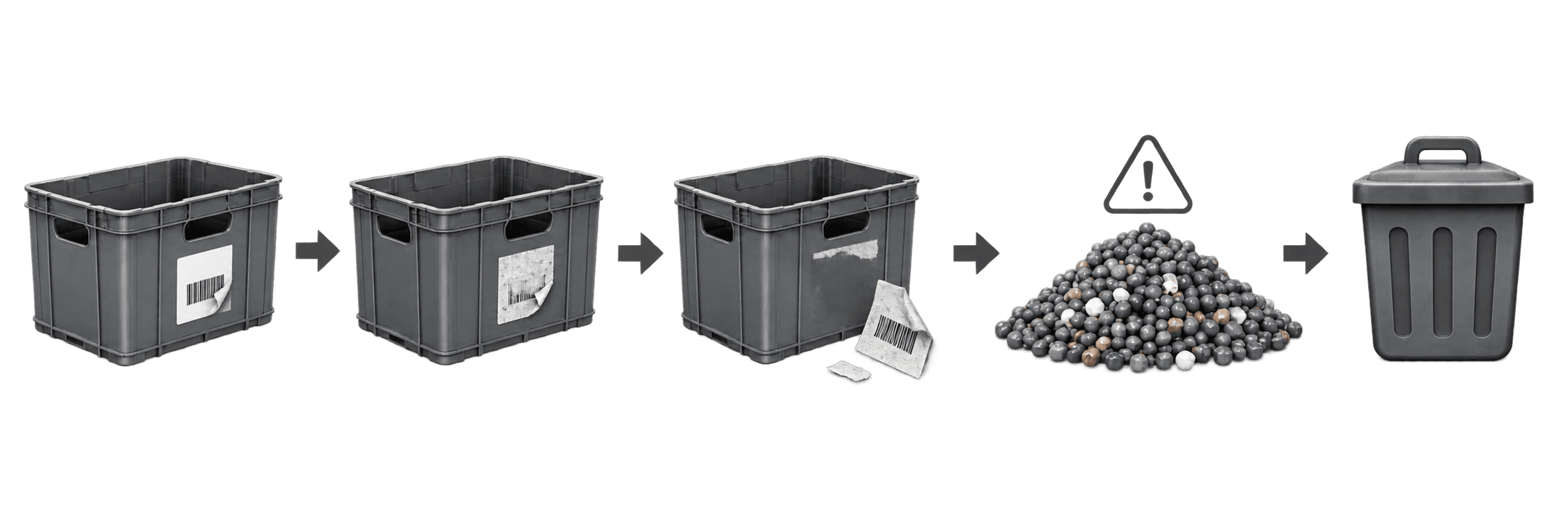
1. MANUFACTURE
Labels and adhesives add secondary materials.
2. USE & TRACK
Labels wear, peel, or fail, making tracking unreliable.
3. RECOVERY
Detached labels contaminate the material stream.
4. RECYCLING
Contamination reduces recyclate quality and limits reuse.
5. DOWNCYCLED OR DISPOSED
Material is downcycled or sent to landfill—the loop is broken.

REGULATIONS ARE CATCHING UP TO REALITY
EPR AND PPWR ARE INCREASING THE IMPORTANCE OF DURABLE, RECOVERABLE PRODUCT IDENTITY.
Around the world, regulations such as Extended Producer Responsibility (EPR) programs and the Packaging and Packaging Waste Regulation (PPWR) are reshaping how products and packaging are designed. Mono-material identity aligns naturally with these objectives by enabling durability, material compatibility, readability, and circularity within a single integrated structure.

AFTER YEARS IN SERVICE
SUSTAINABILITY IS A DESIGN DECISION
THE MOST IMPORTANT SUSTAINABILITY DECISIONS ARE MADE BEFORE A PRODUCT IS EVER MANUFACTURED. MATERIAL SELECTION. PRODUCT ARCHITECTURE. RECOVERY STRATEGY. IDENTITY SYSTEM DESIGN.
These choices determine whether products remain useful, recoverable, and economically viable throughout their lifecycle. Labels and graphics are rarely considered by the product design team. Now is the time to change those past decisions. Sustainability is not a feature added at the end of the process. It is a design decision made at the beginning.
Learn how mono-material identity can support durability, circularity, and lifecycle performance in your application.

DESIGN SUSTAINABILITY INTO THE PRODUCT


EXPLORE YOUR LABEL SYSTEM REQUIREMENTS
Every application environment creates different demands around durability, readability, lifecycle performance, and material compatibility.