

01 /
Engineering Never Stops
Products evolve because engineers discover better ways
One of the great misconceptions about manufacturing is that products evolve because companies decide to change them. They don’t.
Products evolve because engineers discover better ways to solve existing problems. The history of reusable packaging is really a history of engineering priorities; One generation optimized strength. The next reduced corrosion. Another focused on weight. Then manufacturing efficiency. Then global logistics.
Today, engineers are designing for lifecycle performance, automation, and circularity. Every improvement solved the biggest constraint of its era. Every solution created new opportunities.And every opportunity introduced a new engineering challenge.
The products surrounding us today are not simply newer versions of those built fifty years ago. They were engineered for an entirely different world.
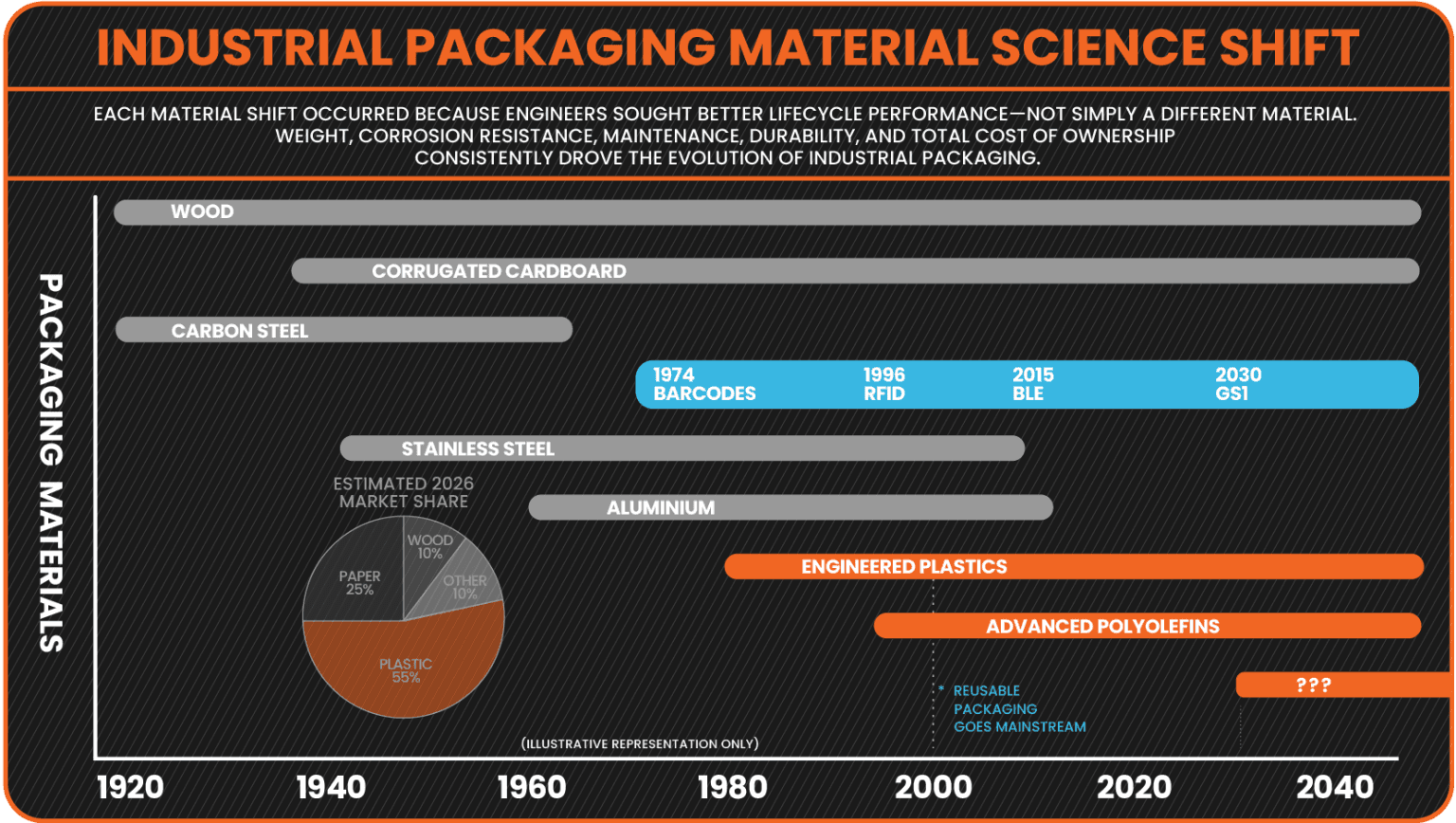
A century of engineering changed materials, identity, supply chains, and business priorities. The timeline tells a story larger than materials alone. As reusable packaging evolved, so did the systems surrounding it. Products became lighter. Supply chains became global. Warehouses became automated. Data became operational.
Circularity became an economic objective rather than simply an environmental aspiration.
Quietly, product identity inherited each one of those changes. What began as paint, stencils, and metal nameplates evolved into pressure-sensitive labels, barcodes, QR codes, RFID, BLE, and persistent digital identity.
Not because identification suddenly became fashionable. Because every new engineering breakthrough placed another responsibility onto the smallest component of the system.
Ownership. Brand recognition. Compliance. Inventory. Automation. Traceability. Recovery. Lifecycle intelligence. The label didn’t become more important. The system did.
Key Insight:
Modern products, modern supply chains, and modern sustainability goals require a different way of thinking about product identity than they did fifty years ago.
02 /
Identity Became Infrastructure
What businesses expected from technology
The biggest change over the past half century wasn’t the barcode. It wasn’t QR codes. It wasn’t RFID. It wasn’t BLE. It was what businesses expected those technologies to accomplish.
In the 1970s, product identity served a relatively modest purpose. It identified a manufacturer, displayed a product name, and perhaps included a serial number or UPC code.
Today, that same identity may support warehouse automation, inventory visibility, maintenance records, product authentication, recalls, reusable asset management, regulatory reporting, digital twins, and circular recovery systems.
The technology itself did not create this transformation. Engineering did.
Every improvement in reusable packaging, automation, analytics, and lifecycle management quietly transferred another responsibility to product identity. What was once considered a consumable label became operational infrastructure.

The purchase price of packaging identity has changed very little over the past fifty years. Even with RFID, BLE and Mono Material innovations. Its value to the business has changed dramatically. That distinction matters.
Because infrastructure is no longer evaluated by its purchase price. It is evaluated by the performance of the system it supports.
And in modern reusable packaging systems, product identity increasingly supports every other system.
03 /
When Infrastructure Fails
Every engineered system has a weakest component
A bridge may be designed to carry thousands of vehicles each day, but its reliability is determined by the smallest structural element within it. Aircraft depend on millions of individual components working together. Electrical grids rely on thousands of interconnected assets performing as designed. Modern supply chains are no different.
Their performance depends upon every layer remaining connected. For decades, product identity was treated as a consumable. Necessary. Replaceable. Inexpensive.
That assumption made sense when identity’s primary purpose was branding or displaying product information. It makes far less sense today.
Modern reusable packaging systems depend on persistent identity to coordinate automation, inventory visibility, asset recovery, maintenance history, regulatory reporting, and increasingly circular operations.
The software may be sophisticated. The warehouse may be highly automated. Artificial intelligence may optimize inventory movement. Yet every one of those systems begins with the same question.
Can the product still be identified? If the answer is no, the rest of the system begins operating with incomplete information. Not immediately. Gradually. One missed scan becomes manual intervention. One unreadable asset becomes a replacement container. One missing identifier becomes an inventory exception.
Multiply that across thousands of reusable assets moving through hundreds of facilities over many years, and what appeared to be a labeling decision quietly becomes an operational issue.
Infrastructure rarely fails all at once. It degrades. Product identity behaves the same way.
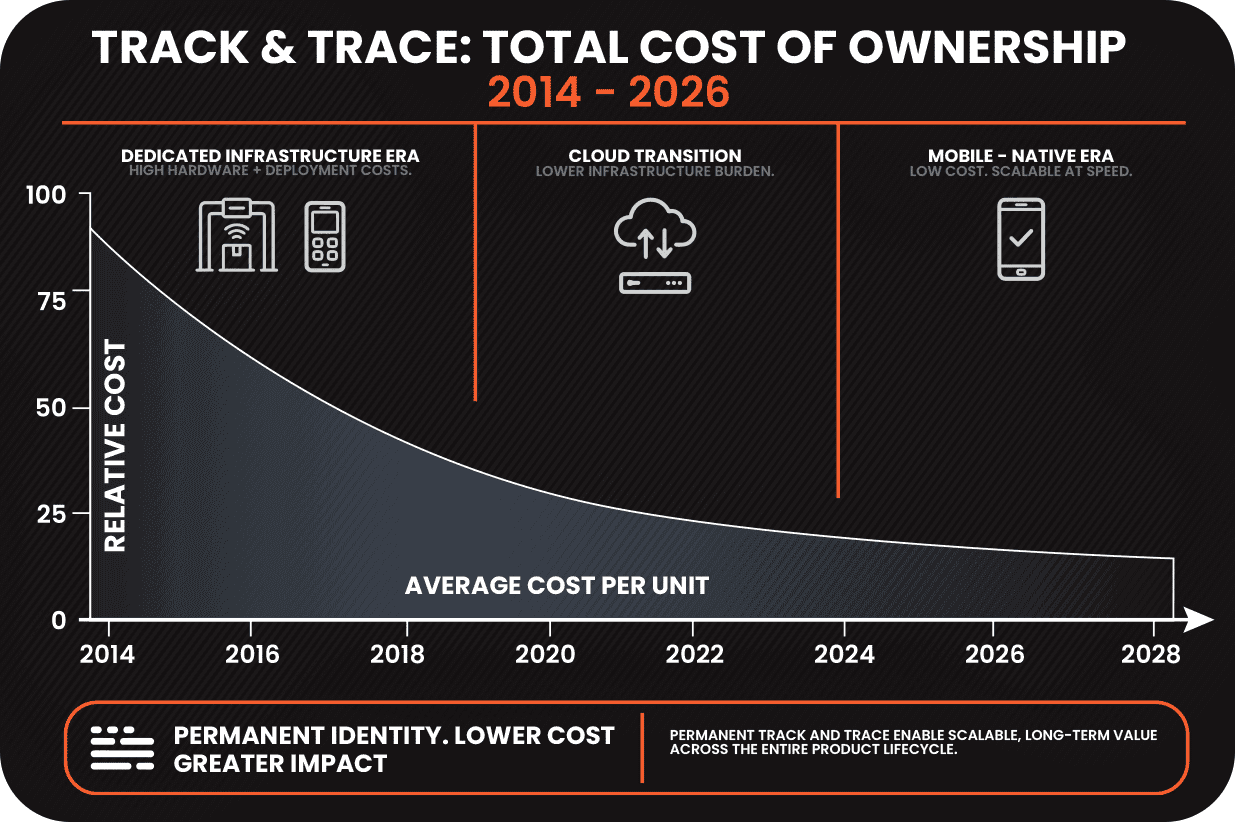
Engineers understand this pattern instinctively. Small component failures never remain isolated. They propagate through the system. The irony is that product identity is often one of the least expensive components purchased and one of the last components engineered.
Yet it may support the most expensive systems inside the operation; Warehouse automation. Enterprise software. Reusable asset pools. Inventory accuracy. Recovery networks. Compliance reporting.
That is why the conversation should no longer begin with: “What does the label cost?”
It should begin with an engineering question. “What does identity failure cost?”
The answer is rarely measured in cents. It is measured in operational friction. And friction compounds.
04 /
Why Plastic Changed The Rules
Modern reusable packaging tells a different story
There is another reason this conversation has become more important over the past two decades.The products changed. The materials changed. The physics did not.
When reusable packaging was predominantly manufactured from wood, stainless steel, and aluminum, attaching identity was relatively straightforward. Paints, coatings, riveted nameplates, and adhesives performed well because the materials themselves readily accepted them. They have High Surface Energy.
Modern reusable packaging tells a different story.
High-density polyethylene, polypropylene, and other polyolefins dominate today’s market because they solve engineering problems that metals cannot. They are lighter, corrosion resistant, chemically durable, easier to manufacture, and ideally suited for years of repeated use.
They also share another characteristic. They were engineered not to let things stick.
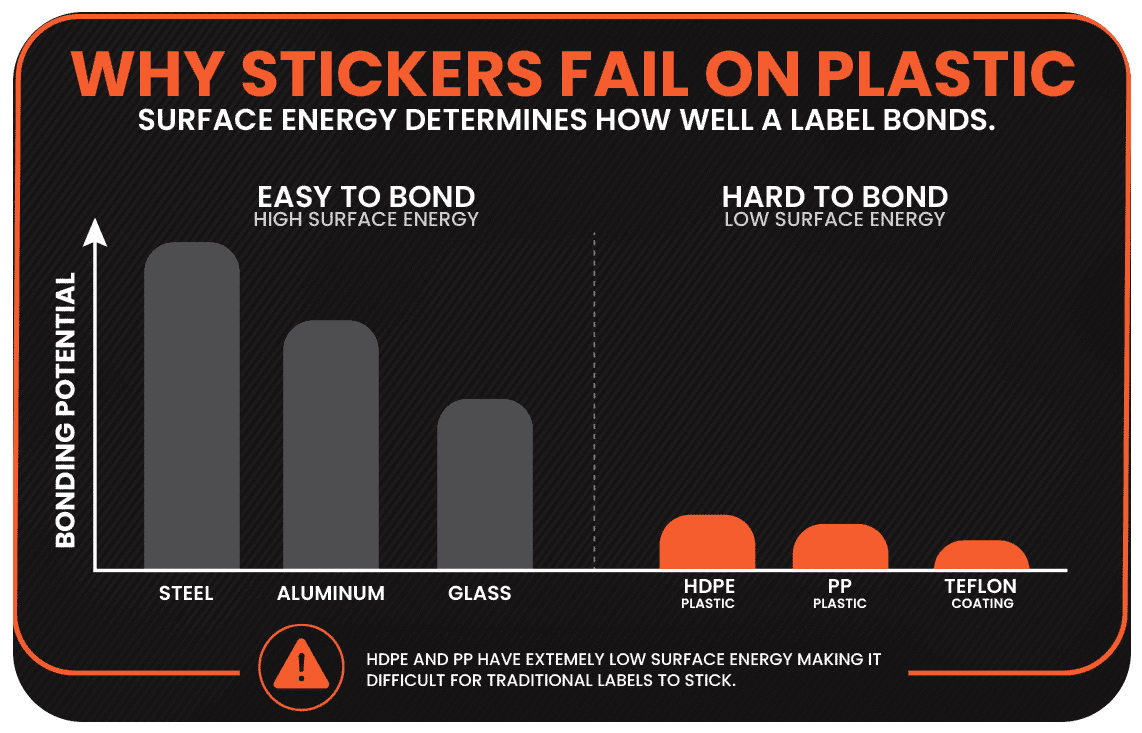
Low surface energy is one of the reasons these materials perform so well in harsh environments. They naturally resist water, chemicals, contamination—and adhesives.
This isn’t a flaw. It is one of their greatest engineering advantages. The challenge is that many identity systems still rely on adhesion to perform. The industry isn’t fighting poor labels. It is often fighting material physics.
Understanding that distinction changes the conversation. It shifts the question from:
“Which label sticks better?” To “Which identity system is best aligned with the material itself?” That is an engineering decision. Not a purchasing decision.
05 /
Designing Identity for the Real World
What are we trying to optimize?
Every engineering problem begins with the same question. What are we trying to optimize?
For decades, selecting a product identity system was often treated as a specification exercise. A label was chosen. A barcode was printed. A purchasing decision was made. Today’s reusable packaging systems demand a different approach. Identity has become part of the engineering architecture of the asset itself.
That means selecting an identity system should begin the same way engineers approach every other design decision with the operating environment.
Start With the Environment. No identity technology is universally superior. Each was engineered to solve a different problem.
A reusable Sephora tote moving through a climate-controlled warehouse has very different requirements than a Tesla battery tote spending ten years exposed to UV light, forklift impacts, wash cycles, chemicals, and outdoor storage.
The question is no longer: “Which technology is best?”
It is: “Which technology is best suited for this environment?”

06 /
Sustainability Begins with Durability
These metrics matter
Sustainability is often measured in recycled content, carbon emissions, or recovery rates.
Those metrics matter. But they begin much earlier than end-of-life. Every replacement label. Every failed RFID tag. Every relabeling event. Every discarded identifier. Consumes additional materials, transportation, labor, and energy.
The most sustainable identity system is often the one that performs for the longest period with the fewest interventions.
Regardless of technology, durability reduces waste. Durability reduces maintenance. Durability reduces resource consumption. In other words, durability is sustainability expressed through engineering.

07 /
The Right Technology Is the One That Fits
Engineers understand there is no perfect material
There is only the right material for a specific application. Identity should be evaluated with the same discipline. Some applications benefit from simple optical systems. Others require radio frequency technologies. Some environments demand integrated identity designed to perform for the life of the asset. The objective is not to specify the newest technology. Nor the least expensive. Nor the most sophisticated.
The objective is to specify the technology that best aligns with the operating environment, the service life of the asset, the business objectives of the organization, and the realities of recovery.
Because engineering has never been about selecting the most impressive solution. It has always been about selecting the most appropriate one.
08 /
Engineering the Next Generation of Systems
Improving one constraint at a time
For more than a century, engineers improved reusable packaging one constraint at a time. They reduced weight. Improved corrosion resistance. Lowered manufacturing costs. Extended service life. Enabled automation.
Today, reusable packaging is no longer simply a product moving through a supply chain.
It has become an intelligent operating system connecting manufacturers, logistics providers, warehouses, customers, recovery networks, recyclers, regulators, and increasingly, artificial intelligence.
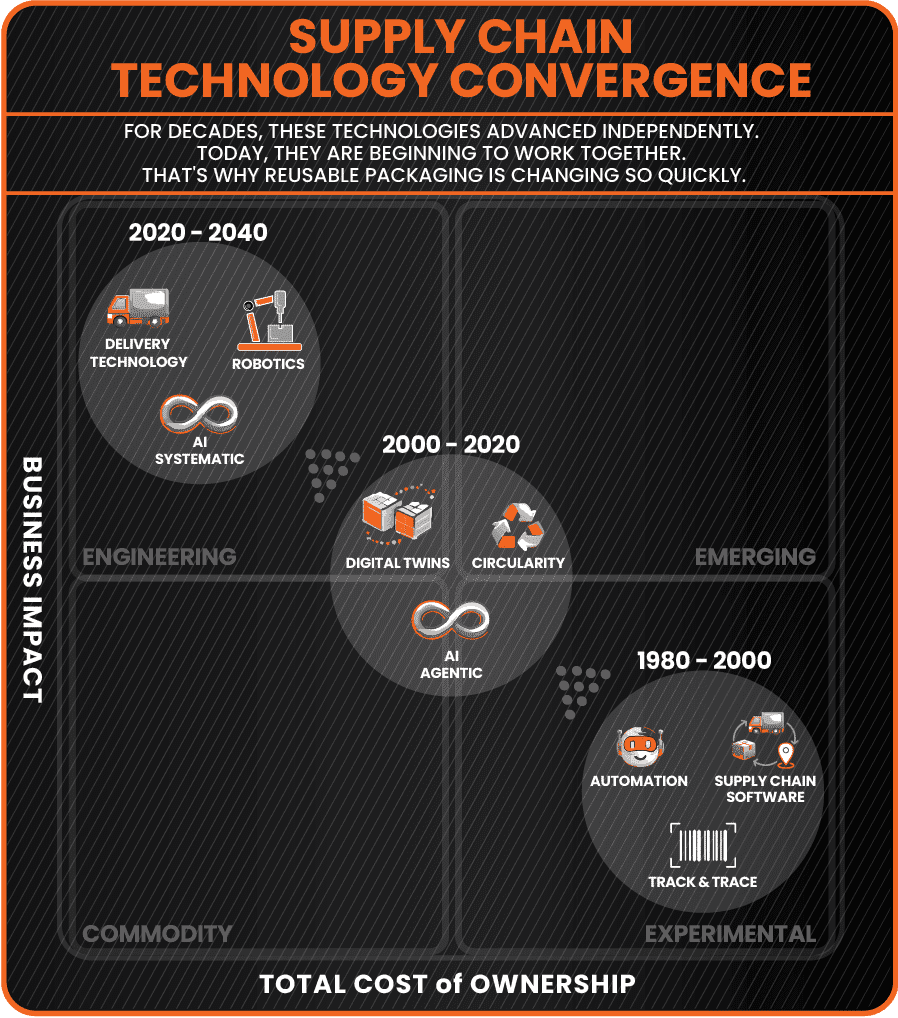
Every movement creates information. Every scan updates inventory. Every wash cycle extends useful life. Every recovery event contributes to circularity. Every interaction depends upon one simple requirement.
The product must remain identifiable. That is why identity can no longer be viewed as an isolated component. It is part of the architecture of the entire system.
The next breakthrough in reusable packaging may not come from a stronger polymer, a faster scanner, or more sophisticated software. It may come from designing every component, including product identity, to perform as an integrated system from the very beginning.
That has always been the engineer’s role. To see connections where others see individual parts. To simplify complexity. To solve the next constraint. The Great Material Shift wasn’t the destination.
It simply revealed the next engineering challenge.
Every generation of engineers inherit a different problem. This one inherits the opportunity to connect the physical product to the digital system for its entire lifecycle.
