
The Weakest Layer: Why Digital Supply Chains Fail at the Label
Resolving the Material-Identity Mismatch in Plastic Packaging
Executive Summary
Modern supply chains are being rebuilt around data. Massive amounts of data. Data feeding AI, automation, digital twins, robotics, ERP systems and more. All that uber critical data is dependent on the identity tag of the asset.
Two-dimensional barcodes, serialized assets, and standards such as GS1 Digital Link promise persistent identity, real-time visibility, and end-to-end traceability. The premise is sound. The foundation is not.
This article examines what we define as the Material–Identity Mismatch:
the disconnect between durable plastic assets and non-durable identification systems.
Most digital supply chain strategies assume that the physical identifier, the label, will remain attached, readable, hygienic, and compatible with the asset throughout its lifecycle. In practice, particularly with polyolefin plastics, this assumption fails.
Labels fail. Not suddenly, but gradually.
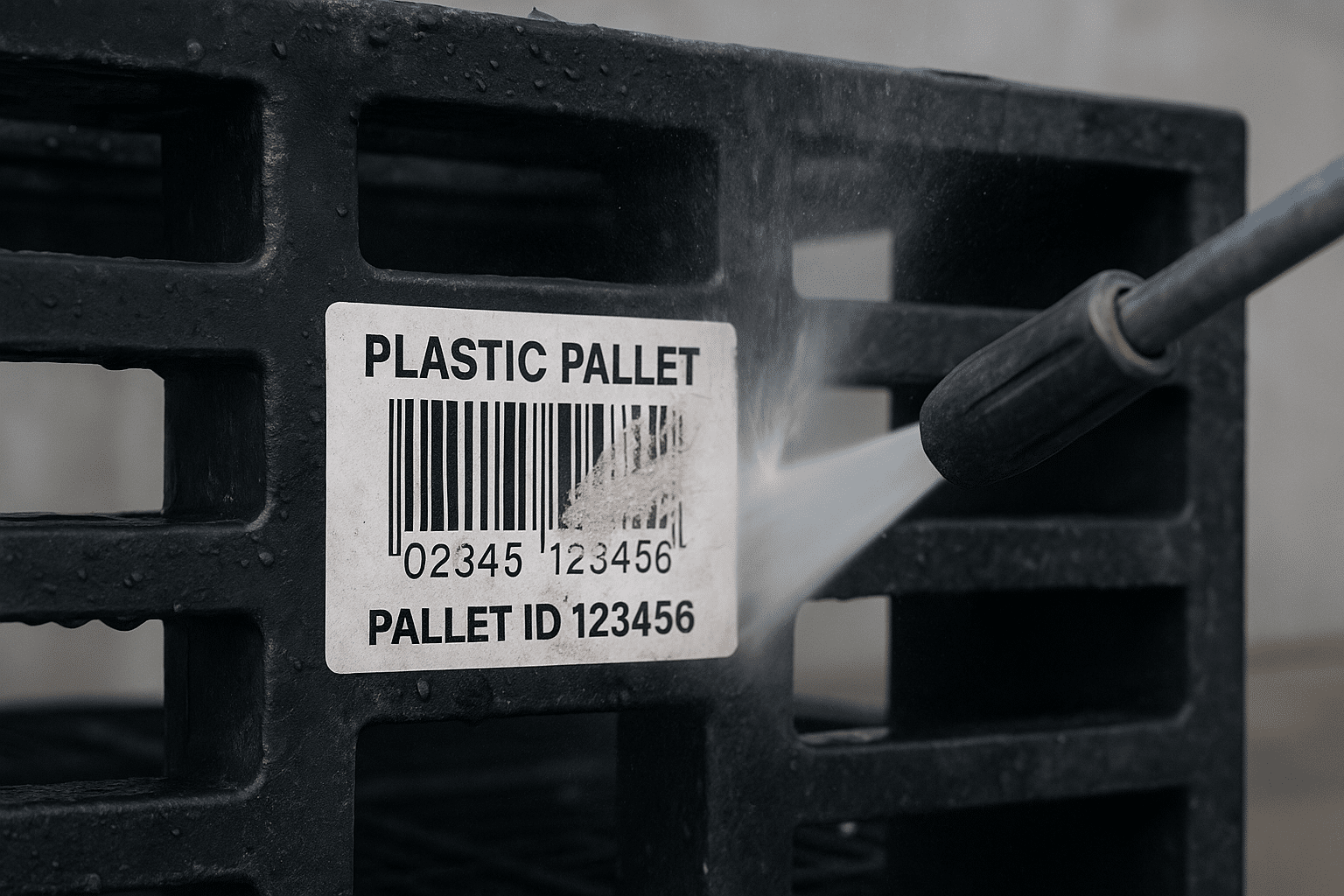
Labels degrade under abrasion, wash cycles, chemical exposure, and most critically, material incompatibility. These failures rarely present as discrete measurable events. Instead, they surface as absorbed labor, declining scan reliability, relabeling routines, asset shrinkage, and eroding trust in systems designed for precision.
Too many organizations invest heavily in modern digital infrastructure while relying on identification methods that were never designed to survive the environments those systems operate in.
The consequence is structural. Total cost of ownership inverts. Automation becomes fragile. Circularity remains theoretical. Resolving this mismatch does not begin with better labels.
It begins with a different question: What happens when identity is designed with the material rather than applied to it?
1. The Inflection Point No One is Talking About
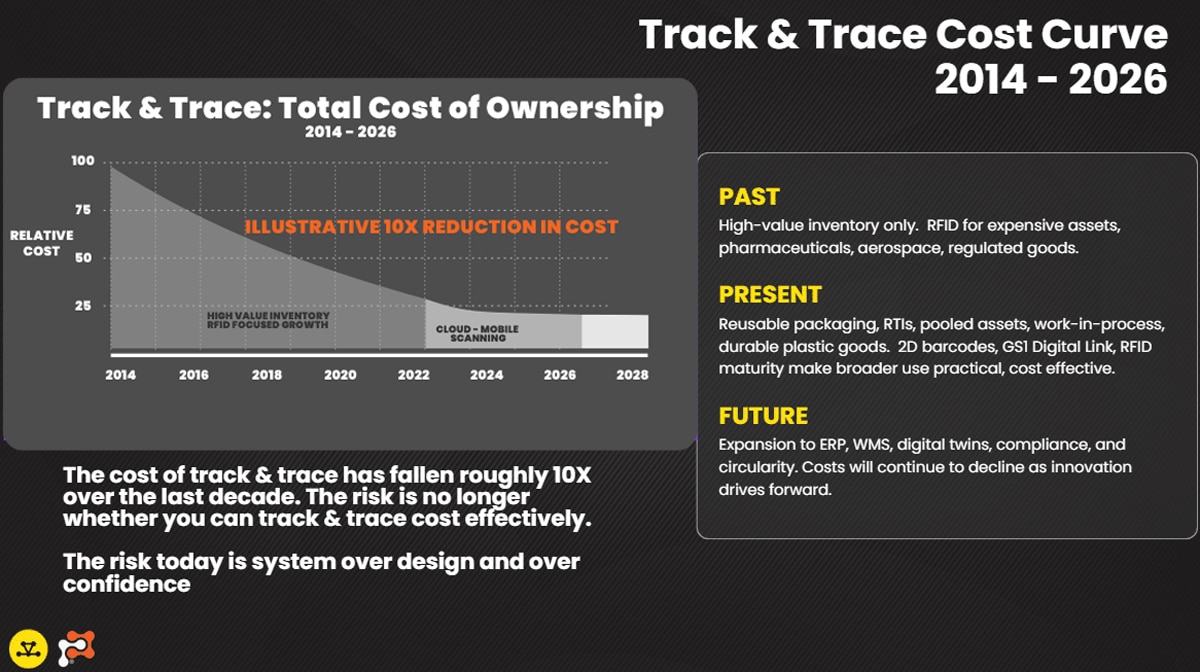
For years, track and trace systems were reserved for the highest-value assets. Pharmaceuticals. Aerospace components. High-value electronics. Not because the technology didn’t exist but because economics didn’t support broad deployment.
That constraint has changed. Over the past decade, the cost of implementing track and trace systems has declined dramatically—by a near 10X order of magnitude.
- Cloud infrastructure replaced on-premise systems.
- Mobile scanning replaced specialized hardware.
- RFID matured.
- 2D barcodes and GS1 standards expanded data capacity without increasing complexity.
What was once economically viable only for high-value assets is now deployable across:
- reusable packaging
- RTIs
- work-in-process inventory
- durable goods
- mid-value logistics flows
The barrier is no longer cost.
Why This Was Not Possible in 2020
In 2020, most organizations were still constrained by one or more of the following:
- high infrastructure cost
- fragmented standards
- limited system integration
- immature data models
Today, those barriers have largely been removed.
Standards like GS1 Digital Link provide a common identity framework. ERP and WMS systems are more interoperable. Data architectures are built to consume identity at scale. The modern supply chain is now capable of tracking far more, far more reliably.
The New Problem: Overdesign and False Confidence
As cost barriers fall, a new problem emerges. Organizations can now overdesign systems. They deploy advanced tracking technologies in environments where:
- identity cannot survive
- labels degrade
- data quality deteriorates
The result is a system that looks sophisticated—but behaves unpredictably.
- More data is collected.
- More dashboards are built.
- More automation is layered on top.
But the foundation remains fragile.
2. The Barcode Renaissance and Its Hidden Dependency
The system isn’t failing because it lacks technology. It’s failing because identity cannot survive the environment.
For decades, the barcode was a disposable infrastructure.
Linear, temporary, and designed for a single moment of truth: the scan at checkout, the confirmation at receiving. Once the transaction was complete, the barcode’s role ended.
That model no longer holds.
Today, the barcode (especially in its 2D form) is being recast as the digital key to the physical world. Across industries, two-dimensional codes are becoming persistent identifiers, expected to function not for minutes, but for years. They enable serialized tracking, automation, regulatory compliance, and emerging circular-economy models.
Standards such as GS1 Digital Link now position the barcode as:
- a serialized identity
- a gateway to lifecycle data
- a connector between physical assets and digital systems
In this model, a single scan can unlock:
- provenance
- compliance data
- usage instructions
- full lifecycle history
This is a fundamental shift. The barcode is no longer convenient. It is infrastructure. But infrastructure has a requirement.
It must persist.
3.The Assumption No One Questions
Nearly every discussion of digital identity in supply chains rests on an unstated assumption: That the label will simply work.
It is assumed that the label will remain attached for the life of the asset, stay readable after abrasion and wash cycles, survive chemicals and UV exposure, maintain hygiene in regulated environments, and disappear harmlessly at end of life without compromising recyclability.
These assumptions are rarely examined. They are implied, not tested (don’t get us started on the antiquated ASTM test for labels). This is where the system begins to fracture.
A barcode that cannot be scanned is not a minor inconvenience. It is a single point of system failure. When the scan fails, automation slows. Data continuity breaks. Assets fall out of visibility. Compliance confidence erodes.
The intelligence layer of the supply chain fails when the physical layer is incompatible.
Silent Assumption
If the barcode exists, it will remain readable.
Industrial vision system audits routinely show barcode read-rate degradation of 20–40% within the first year on reusable plastic assets using adhesive-based labels in wash-intensive environments.
4. The System Is Now Affordable.
The Failure Is Now Structural.
Ten years ago, failure to implement track and trace systems was often an economic decision. Today, failure is rarely about cost. It is about design. Organizations are deploying:
- RFID systems
- 2D barcode infrastructures
- digital twins
- automated tracking systems
At scale. But they are often doing so on top of identification layers that were never designed to survive:
- abrasion
- wash cycles
- automation handling
- chemical exposure
- multi-year reuse
The result is a structural mismatch. The system is modern.
The identity layer is not.
5. The Illusion of Stability
The modern supply chain increasingly relies on the concept of the digital twin; a persistent, real-time representation of a physical asset.
But a digital twin is only as reliable as the link that connects it to reality.
When labels degrade, that link becomes probabilistic rather than deterministic. The system continues to operate, but on corrupted assumptions. Assets appear present when they are not. Histories fragment. Traceability becomes incomplete. Exceptions increase.
This is the illusion of stability: a system that appears digitally intact while its physical identifiers quietly fail. In this condition, more data does not create more certainty. It amplifies hidden error.
6. The Physical Reality of Plastic That Digital Narratives Ignore
Plastic is not the problem. Plastic is the constraint that exposes weak system design.
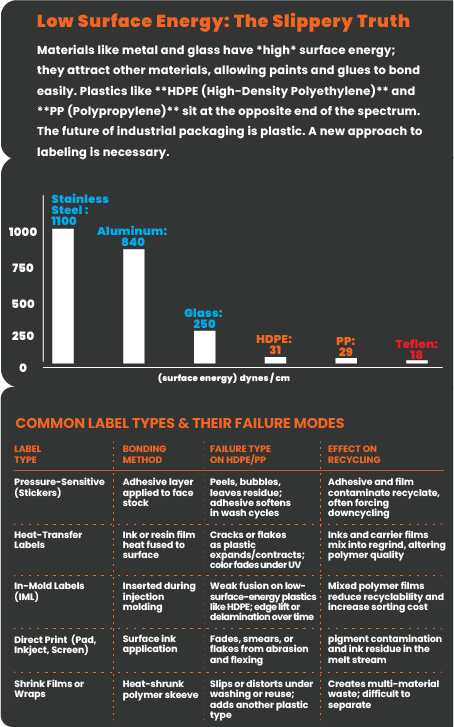
Polyolefin thermoplastics—polyethylene, polypropylene, UHMWPE—dominate reusable packaging and durable assets because they are chemically resistant, impact durable, lightweight, and designed for long service life. And critically: Designed to resist bonding.
These materials have inherently low surface energy. Adhesives do not integrate, they sit on top of the plastic.
These properties make traditional labeling fundamentally unreliable.
Polyolefins have low surface energy. Adhesives do not bond; they rest on the surface. Over time, additives such as mold-release agents migrate outward, forming invisible barriers that further degrade adhesion. Thermal cycling, flexing, and abrasion accelerate failure. Industrial wash cycles—heat, pressure, chemicals compound it.
The plastic endures. The label does not.
At end of life, adhesive labels introduce foreign materials into otherwise clean recycling streams, complicating processing and reducing material value.
Plastic does not fail the digital vision. Incompatible labeling does.
7. Reframing the Problem
The industry treats labeling as a performance problem:
- Stronger adhesives
- Better coatings
- Thicker constructions
But these are all attempts to extend the life of something that was never materially aligned with the asset. This is not a durability problem. This is not a print problem. This is not even a label problem.
This is a compatibility problem.
8. From Compatibility to Mono Material
If the interface between identity and material is the failure point. Then the interface must be reconsidered. This is where monomaterial solutions emerge.
Not as an innovation in labeling. But in response to incompatibility. By aligning the identifier within the same material family, the dependency on adhesion begins to disappear.
No competing chemistries. No foreign interface. No gradual separation. But even this framing is incomplete.
Because it still assumes we are improving labels.
Hidden Cost:
Most label failures are expensed as labor, not recorded as downtime.
Data Anchor:
In closed-loop logistics systems, relabeling activity is often absorbed into routine labor, obscuring true cost by 5–15× compared to line-item consumable spend.
9. The Hidden Cost of Incremental Failure
Most organizations do not budget for label failure. They budget for automation, software, containers, labor, and compliance. Labeling is treated as a rounding error; a consumable, not a system dependency.
On durable plastic assets, failure is incremental. And incremental failure is the most dangerous kind.
Scan reliability declines gradually. Automation slows. Manual intervention increases. Relabeling becomes routine. Assets fall out of systems. Data confidence erodes. Hygiene risks emerge.
None of these effects trigger alarms. They accumulate slowly and soon the cost easily hits millions.
By the time they are visible, the system is already compromised. This is where total cost of ownership inverts. What appears inexpensive at the outset, traditional labels, accumulates hidden costs through labor, downtime, relabeling, asset loss, and compliance risk.
In many cases, the label becomes more expensive than the asset it was meant to identify.
10. Why “Better Labels” Fail
The industry’s response has been consistent: Improve the label.
But improvement within an incompatible system does not resolve failure. It delays it.
As long as identity is materially different from the asset, the interface remains conditional. And conditional systems do not scale.
11. A Real-World TCO Inflection Point
One large U.S.-based automotive manufacturer provides a representative example. Operating a billion-dollar global supply chain, the company invested heavily in automation, track-and-trace systems, packaging design, and logistics optimization. Millions were spent to eliminate inefficiencies and improve predictability.
Yet this highly optimized system remained vulnerable to a three-cent label.
Traditional labels failed repeatedly across reusable plastic containers, forcing ongoing relabeling, introducing labor and downtime costs, and undermining data integrity. When the company modeled total cost of ownership across multiple years, the conclusion was unambiguous. Although mono-material labels carried a higher initial unit cost, they eliminated relabeling, reduced asset loss, preserved production uptime, and improved recyclate value. Over a three-year period, total cost of ownership was approximately fifteen times lower than the traditional labeling approach.
More importantly, the system became predictable. Disruption declined. Automation regained reliability. The label ceased to be a source of risk.
12. A System Designed for Precision, Undermined by Adhesion – Real World Example
A Tier 1 automotive manufacturer operating millions of reusable plastic containers across North America encountered this mismatch directly.
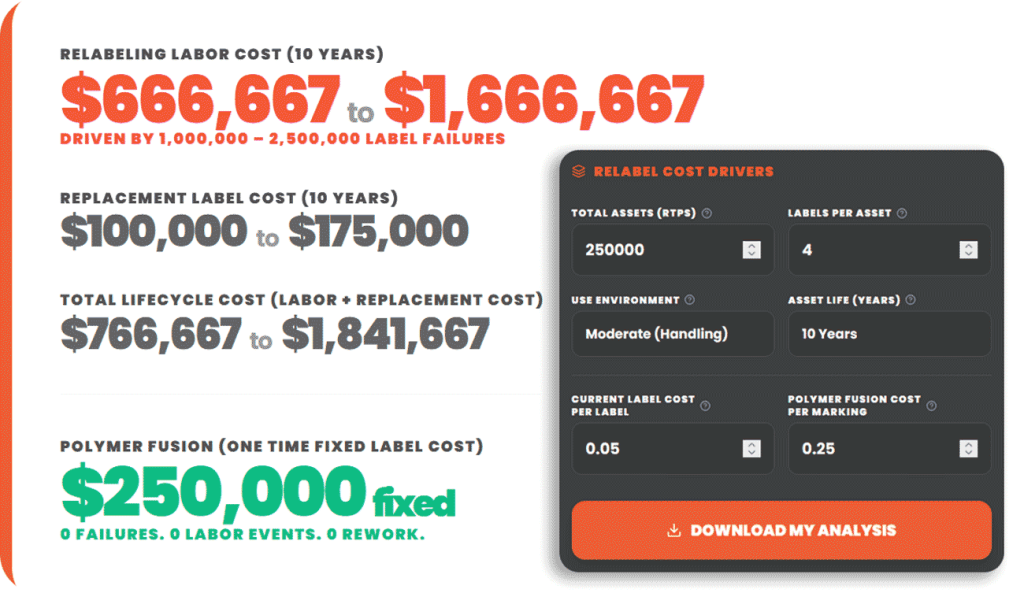
Despite significant investment in automation, tracking systems, and logistics optimization, more than 30% of labels required replacement within the first year. Relabeling became a continuous operational burden. Scan failures introduced downtime. Data integrity weakened.
When the company modeled total cost of ownership across a three-year lifecycle, the result was decisive.
Mono material labeling—though higher in initial cost—eliminated relabeling, reduced asset loss, preserved uptime, and improved recyclate value. The system transitioned from reactive to predictable.
Total cost of ownership was approximately 15× lower than the adhesive-based approach.
The most important outcome was not cost reduction. It was system reliability.
13. Why “Better Labels” Fail to Solve the Problem
The industry’s response to label failure has been incremental: stronger adhesives, thicker laminates, protective overlays, encapsulated tags.
Each adds cost and complexity. None resolve the underlying constraint.
As long as the label is materially different from the asset, the interface remains conditional. Adhesion is probabilistic. Durability varies. Hygiene requires intervention. Recyclability is compromised.
Improving an incompatible interface does not fix the system. It delays failure.
Language Reset:
Durability is not only longevity. It is predictability. And predictability is the modern supply chains greatest advantage.
14. Mono-Material Labeling as a System Correction
Mono-material labeling is often described as a better label. It is not. It is a correction of a design error. By aligning the identifier and the substrate within the same polymer family, the interface disappears. There is no adhesive layer, no foreign material boundary, no delamination pathway.
The label becomes part of the asset.
When identity is materially integrated:
- Durability becomes predictable
- Scan reliability persists across years and wash cycles
- Hygiene is inherent
- Automation regains confidence
- Recyclability becomes operational, not theoretical
This is not about adding intelligence. It is about preserving it.
Conclusion
The future of supply chains is often described as digital. But digital systems do not exist in isolation. They depend on physical interfaces; points where data meets material reality.
Today, that interface is the weakest layer.
As long as identity is applied to plastic rather than integrated with it, supply chains will continue to experience hidden failure, rising cost, and unrealized potential.
Resolve the Material-Identity Mismatch, and the system stabilizes. Ignore it, and no amount of digital sophistication will compensate.
Data only creates value for as long as identity allows it to remain true.
Industry Leaders Choose The Polyfuze Advantage































About Polyfuze
Polyfuze’s revolutionary Mono Material labeling technology represents a major breakthrough in sustainable industrial packaging. Unlike traditional labels that use incompatible materials and adhesives, Polyfuze permanently fuses branding, barcodes, RFID and compliance information directly into the surface of polyolefin products like HDPE and PP.
The result is a label that never peels, fades, or contaminates the recycling stream—ensuring full compatibility with closed-loop and circular economy goals.
Engineered for demanding use cases such as pallets, totes, crates, and IBCs, Polyfuze empowers OEMs and end users to meet rising sustainability standards without sacrificing durability, traceability, or performance. As the only labeling solution of its kind, Polyfuze is redefining what’s possible in recyclable, reusable packaging.
Established in 1983, we bring over four decades of expertise in plastics labeling and graphics. Our founder’s entrepreneurial spirit remains a driving force in our culture, fueling a commitment to innovation that begins with listening closely to our customers.
Tell us about your application and we’ll help you determine if Polyfuze is the right fit.
We’ll review:
- Material compatibility
- Labeling method
- Volume and scale
- Implementation approach