
Designing Identity Into Plastic:
The Mono Material Labeling System
Polyfuze enables product identity at the material level for the life of the asset
Executive Summary
Designing Identity into Plastic, the Mono Material Labeling System
Key Points
- Plastic lasts for years; most labels do not.
- Identity is now critical to automation, traceability, branding, and recycling.
- Low-surface-energy plastics (PP, PE) resist traditional adhesive and surface printing.
- Mono material labeling uses the same polymer family as the plastic part.
- Polymer fusion bonds the label into the plastic using heat and pressure, not glue.
- Traditional methods (PSA, digital UV, IML, hot stamp) degrade or separate over time.
- Mono material fusion fails only when the plastic itself fails.
- Labeling is shifting from an applied layer to an engineered material feature.
Summary
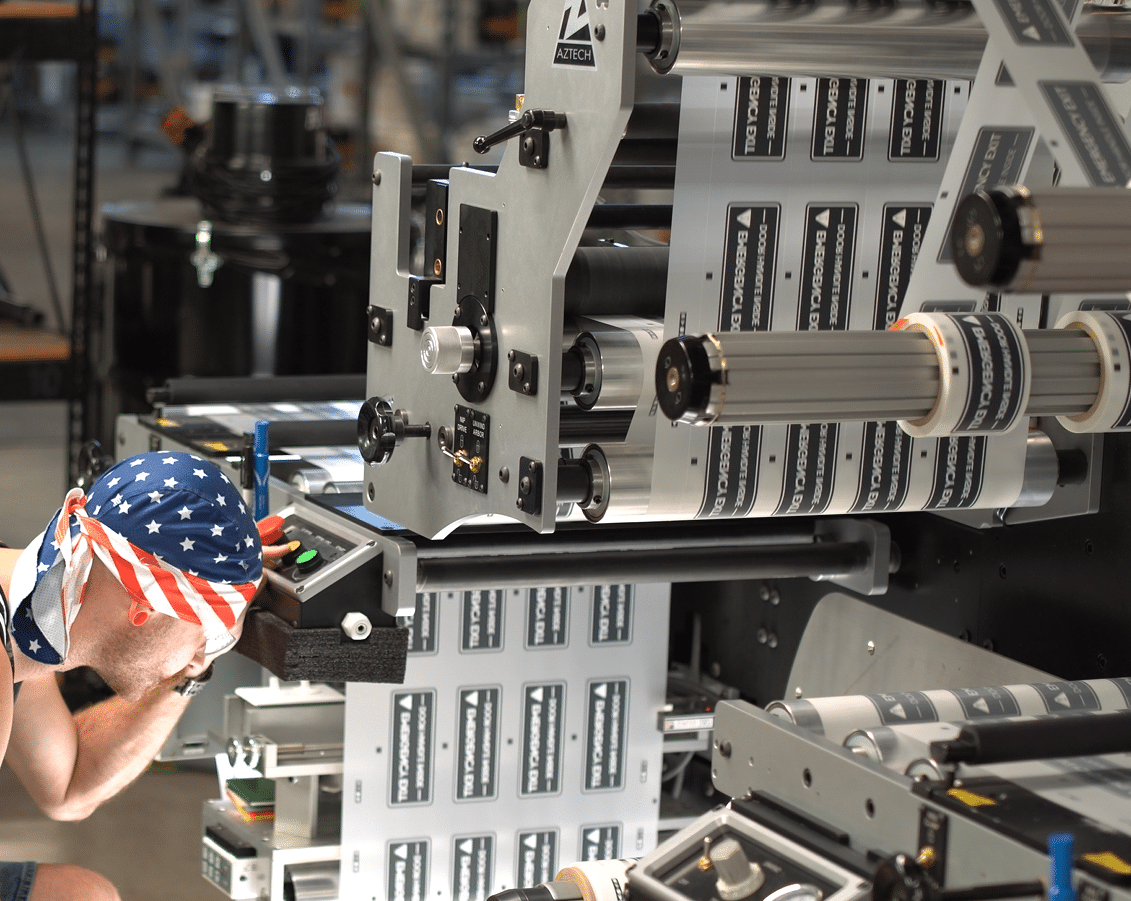
When identity fails, products stop functioning as assets. Polyfuze ensures they remain commercially viable over time. Mono material labeling addresses this by aligning label and substrate materials and fusing them together without adhesives, allowing identity to age with the product itself. This approach improves durability, branding, and enables reliable machine-readable data over the full life of the asset.
The Paradox of Plastic
Plastic is one of the most successful materials ever invented. It is light, durable, moldable, and inexpensive. It resists water, oils, chemicals, and abrasion. It survives heat, cold, and repeated use. Modern supply chains are built on it. From Automotive parts to GRACO sippy cups, we are built on polyolefins.
We can manufacture a tote that lasts decades yet identify it with a label designed for weeks. We build automated systems that depend on flawless data, then attach that data using adhesives that degrade in wash systems, UV light, and friction. The result is a paradox: the stronger our plastic systems become, the more fragile their identity layer remains.
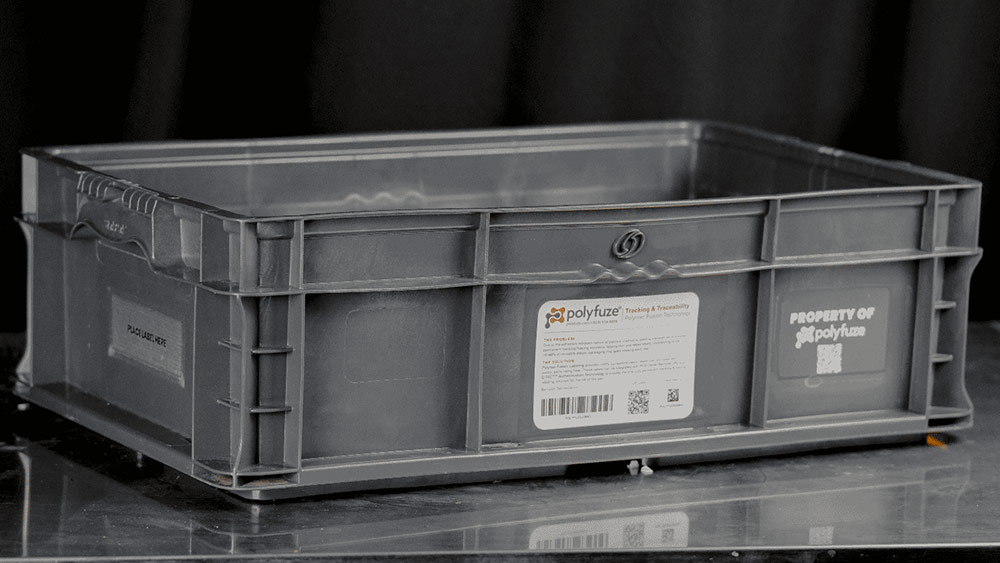
“Plastic evolved. Labels didn’t.” — Design Engineer
Mono material labeling exists because this mismatch has become impossible to ignore. It is no longer a branding or adhesive problem. It is a materials problem. One that starts with a simple question:
What if the label was one with plastic instead of fighting to repel it?
What Is Mono material (and Why LSE Plastics Need It)
Mono material labeling means the label and the product are made from the same polymer family; polypropylene on polypropylene, polyethylene on polyethylene with no foreign adhesive layer acting as an intermediary.
Instead of sticking something onto plastic, mono material labeling fuses with it.
This matters most for low surface energy (LSE) plastics — the polyolefins that dominate reusable packaging, medical devices, industrial components, and consumer goods. These materials are engineered to repel.
For decades, the industry compensated with surface treatments, aggressive glues, and layered constructions. The label became a chemical compromise applied to a material that never wanted it there. Over time, that compromise appears as peeling corners, scratched barcodes, and disappearing identity.
How It Works (Without the Lab Coat)
At its core, mono material labeling is a physics problem, not a chemistry trick.
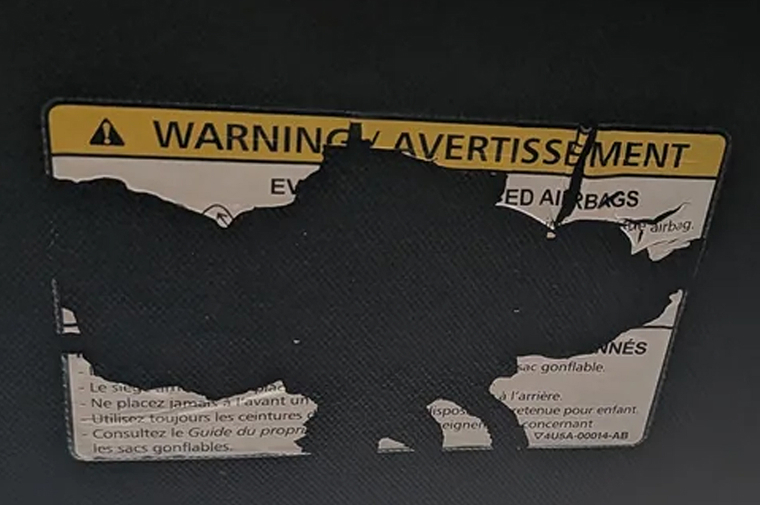
Heat softens polymer chains. Pressure brings materials into intimate contact. At the molecular level, compatible polymers entangle.
Polyfuze uses controlled heat and pressure to create a molecular bond between the label and the plastic surface. Instead of sitting on top of the part, the label becomes part of it. There is no adhesive layer acting as a buffer. No surface-energy dependency. No chemical cure waiting to happen.
Polymer Fusion Labeling can be used with the following plastic types:
- Polypropylene
- Glass-Filled PP (Polypropylene)
- Talc-Filled PP (Polypropylene)
- HDPE (High-Density Polyethylene)
- LDPE (Low-Density Polyethylene)
- MDPE (Medium-Density Polyethylene)
- UHMW (Ultra High Molecular Weight Polyethylene)
- TPE (Thermoplastic Elastomers)
- TPO (Thermoplastic Polyolefin)
- TPV (Thermoplastic Vulcanizates)
- EVA Foam
- Structural Foam
- SEBS (Styrene-Ethylene-Butylene-Styrene)
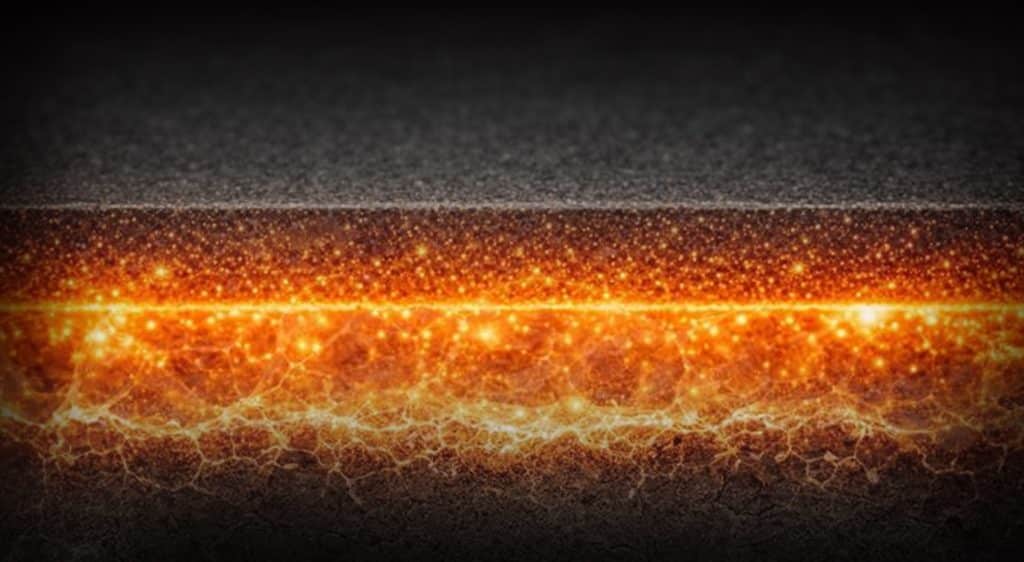
Just as important, the process fits into industrial reality. It works with molded parts. It works with automation. It does not require exotic materials or slow cure cycles. It produces permanence at manufacturing speed.
Permanence is no longer applied after the fact. It is engineered into the part.
Why Traditional Labeling Fails Plastic Systems
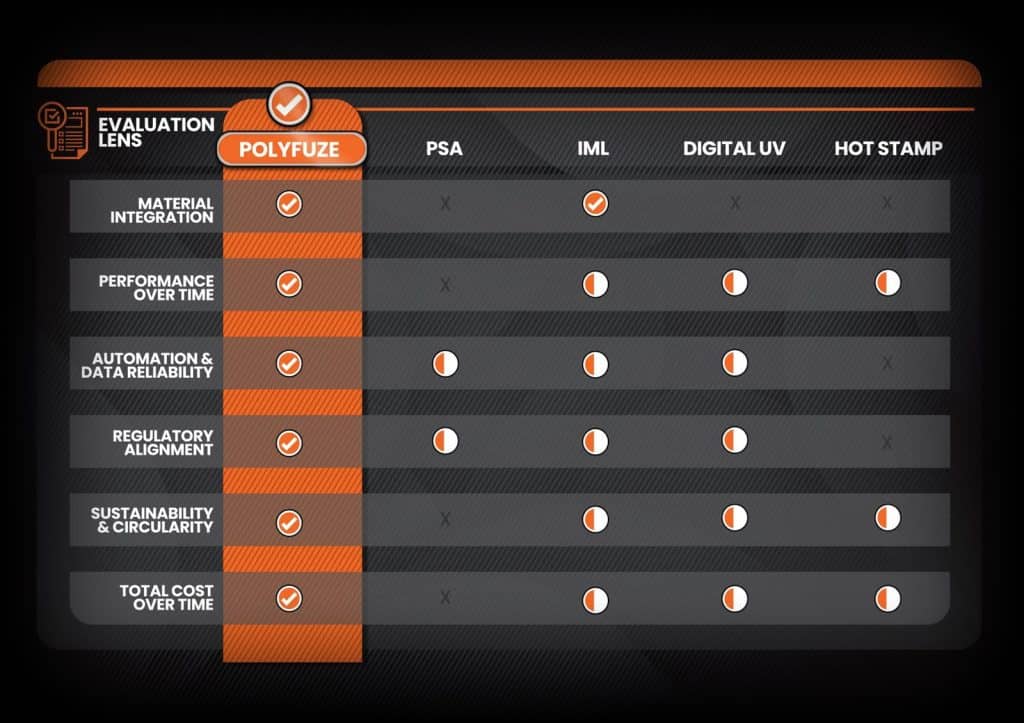
There are four dominant ways to put identity on plastic today: pressure-sensitive adhesives (PSA), in-mold labeling (IML), hot-stamped foil, and mono material fusion.
Each solves a different problem. Each fails in a different way.
Pressure-sensitive labels rely on adhesion to survive. On low surface energy plastics, survival is temporary. Wash systems attack the glue. Abrasion attacks the print. Corners lift. Barcodes smear. Identity slowly unravels.
Digital UV printing cures ink directly onto the plastic surface, often with primers or surface treatment. While it eliminates a physical label layer, it still depends on surface adhesion. The graphic may remain partially visible while the data becomes unreadable.
In-mold labeling embeds a label into the molding process but introduces a new material layer into the part. That layer may look integrated, but it remains chemically distinct. Over time, it can delaminate, distort, or interfere with recycling streams.
Foil stamping solves for appearance and permanence, but at the cost of flexibility. It cracks on textured surfaces, limits data density, and introduces metallic contamination into recycling flows. It solves visibility by sacrificing material harmony.
Mono material fusion takes a different path. Instead of forcing one material to stick to another, it aligns them. Label and substrate share a polymer family. Their aging behavior matches. Their recyclability aligns. Their failure modes converge.
Why Label Performance Matters Now
Labels were considered an afterthought until their role evolved. When containers were handled manually and data was sparse, a human could read a faded sticker and keep moving. Identity was visual. Errors were local. That world is gone.
Modern systems depend on machine vision, automated sorting, high-speed washing, and serialized tracking. Barcodes are no longer backups. They are control signals. They route containers. They verify the contents. They trigger compliance actions. They close digital loops.
“The label is no longer branding. It’s infrastructure.” — Supply Chain Manager
The cost of label failure is rarely limited to replacement. It shows up as lost containers, misroutes, downtime, brand integrity loss and exceptions that humans must resolve manually. It appears as contamination in recycling streams and gaps in traceability records.

The Future of Labeling
The weakest layer in the system is finally being redesigned.
As plastic systems become smarter, their identity systems must become more material-aware. Sustainability requires compatibility. Automation requires permanence. Traceability requires trust.
Mono material labeling is not a feature trend. It is a design principle. The same logic driving mono material packaging is now reaching the identity layer. The materials must agree. The system must age as one.
Plastic no longer has to choose between durability and identity. It can have both.
About Polyfuze
Polyfuze’s revolutionary Mono Material labeling technology represents a major breakthrough in sustainable industrial packaging. Unlike traditional labels that use incompatible materials and adhesives, Polyfuze permanently fuses branding, barcodes, RFID and compliance information directly into the surface of polyolefin products like HDPE and PP.
The result is a label that never peels, fades, or contaminates the recycling stream—ensuring full compatibility with closed-loop and circular economy goals.
Engineered for demanding use cases such as pallets, totes, crates, and IBCs, Polyfuze empowers OEMs and end users to meet rising sustainability standards without sacrificing durability, traceability, or performance. As the only labeling solution of its kind, Polyfuze is redefining what’s possible in recyclable, reusable packaging.
Established in 1983, we bring over four decades of expertise in plastics labeling and graphics. Our founder’s entrepreneurial spirit remains a driving force in our culture, fueling a commitment to innovation that begins with listening closely to our customers.