
The Next Evolution of Plastic Labeling:
Defining the Mono Material Labeling Category
Why the Future of Plastic Labeling Isn’t Adhesive — It’s Fusion.
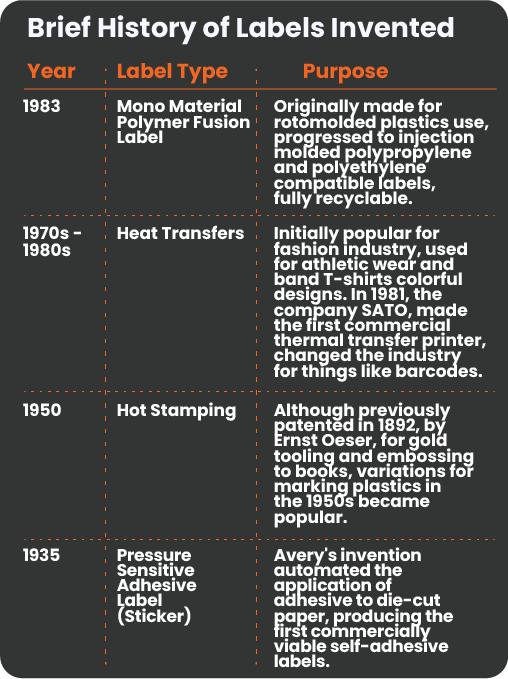
Every Label Was Modern Once
For decades, labeling technology has mirrored the progress of packaging itself. When pressure-sensitive adhesives replaced mechanical nameplates, it was modern. When in-mold labeling streamlined decoration for injection-molded parts, it was modern. When UV-cured inks replaced solvents, that too was modern.
Each step forward made sense for its time — built for an economy optimized around single-use plastics, speed, and cost efficiency. These technologies solved the challenges of their generation: marking products quickly, beautifully, and at scale.
But “modern” has a half-life.
As the world shifts from disposable to durable, from single use to multi-use, a quiet mismatch has emerged between labeling methods designed linear systems and the circular systems they now inhabit.
Innovation doesn’t fail; it outlives its context.
When New Modern Meets Circular
The rise of reusable packaging systems, from retail transport packaging to reverse logistics and industrial asset pools, has rewritten the design brief. A new approach to circular design.
Suddenly, the label is no longer temporary. It must endure the same number of cycles, washes, impacts, and exposures as the plastic container itself. And in the era of Extended Producer Responsibility (EPR), it must also merge correctly — without contaminating recycling streams or complicating material identification.
The tension is simple:
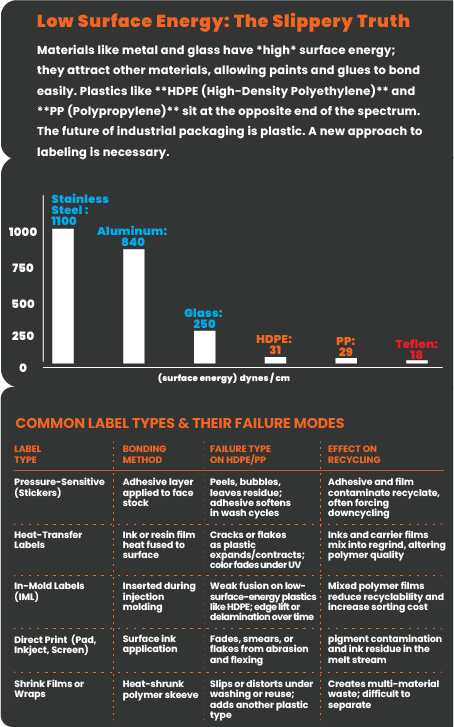
A PSA label wants to stay on, until it doesn’t. A removable tag wants to come off, until it leaves residue. An in-mold label bonds initially well but not forever, and rarely with perfect material compatibility.
Circularity, it turns out, doesn’t just require new systems. It requires new chemistry.
The Breakthrough – Mono Material Labeling Defined
Enter Mono Material Labeling, a new category of plastic labeling born for circularity.
Definition:
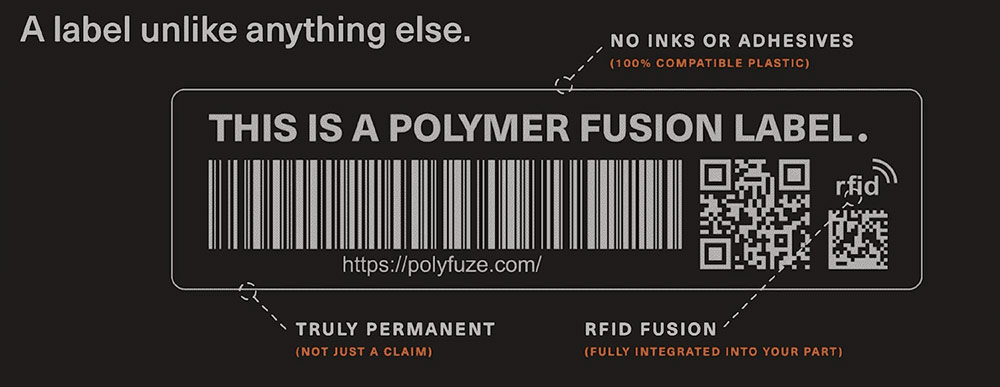
A labeling method that fuses molecularly with the same base plastic, creating a single, inseparable material identity.
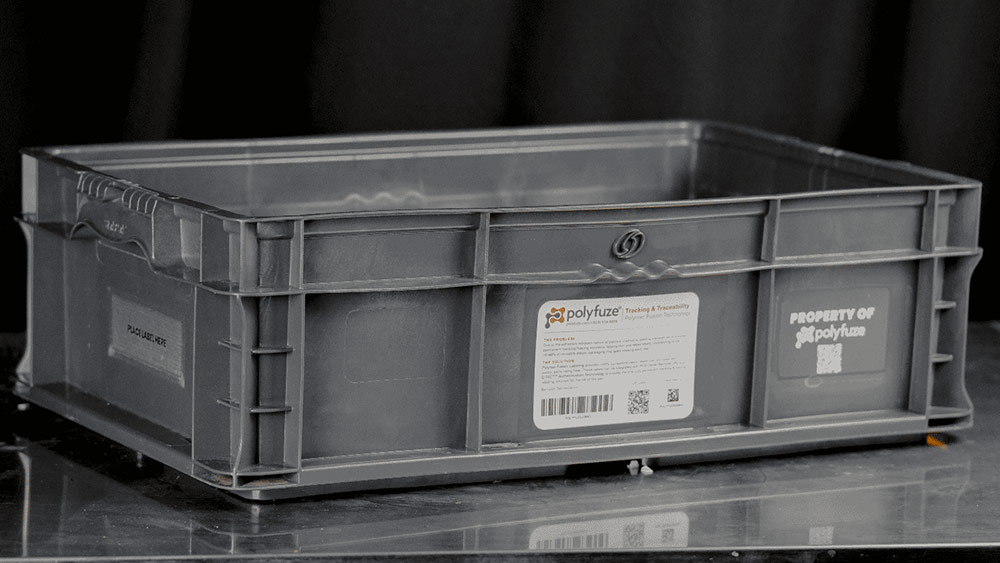
Unlike the adhesive illusions that sit on top of the surface, mono material labeling becomes part of it. No adhesives. No laminates. No foreign inks. Only the same polyolefin fused to itself. indistinguishable in composition, inseparable in performance.
It’s not another label. It’s a continuation of the material itself.
“When the label and the container share one molecular language, recyclability stops being an aspiration — it becomes chemistry.”
How It Works – The Science of Fusion
At the heart of mono material labeling lies Polymer Fusion, a process that joins two polymer materials not by mechanical adhesion, but by molecular interdiffusion. In simple terms: the label and the plastic are the same material, so their molecules blend and lock together under controlled heat and pressure.
The result:
- A single, homogenous surface
- Identical melt flow and recyclability properties
- No secondary layers or contaminants
Here’s how it compares to what came before:
Mono material labeling doesn’t need removal, reapplication, or specialized recycling streams. When ground, washed, or remolded, it behaves like plastic because it is plastic.
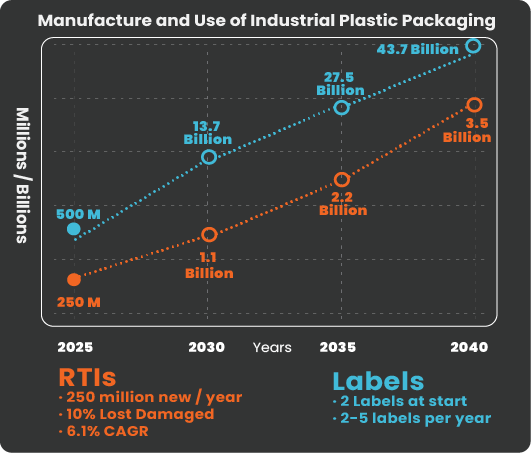
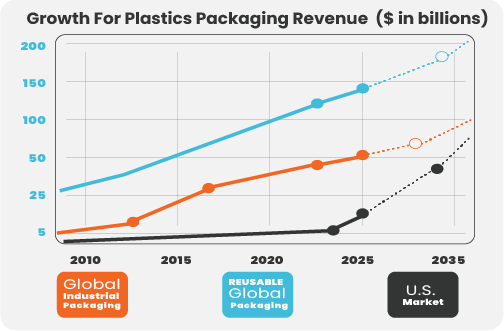
The model assumes a clean slate in 2020. The sheer scale and strategic importance of these assets demand a new focused approach. Maybe more significantly is the environmental impact of 40 billion labels in landfills and a yield of only 70% for reusable packaging recyclability.
The Implications – When Label Becomes Mono
-
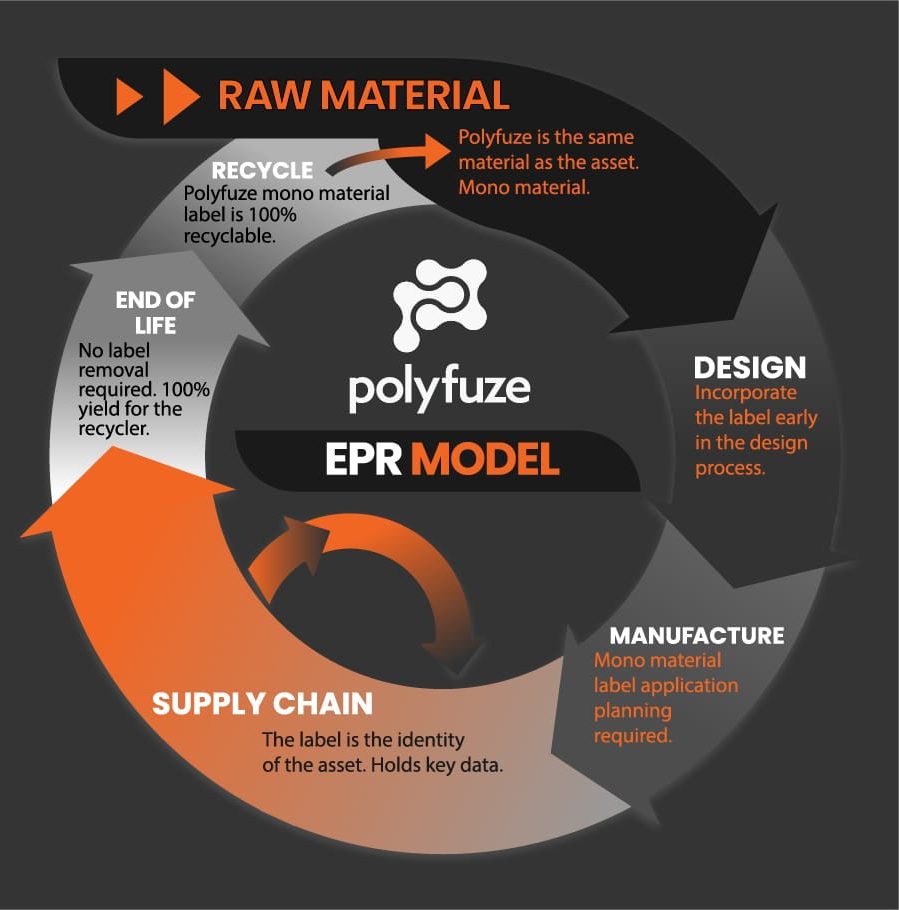
True Circularity
No separation required. Mono-material labeling ensures a container, tray, or component reenters the recycling stream with zero contamination. -
Extended Lifespan
Labels that last as long as the product increases the need for asset tracking, branding, or regulatory marks remaining intact through thousands of reuse cycles. -
Extended Lifespan
Labels that last as long as the product increases the need for asset tracking, branding, or regulatory marks remaining intact through thousands of reuse cycles.
When Systems Shift – Every Revolution Meets Resistance
Technology rarely changes the world by itself. It changes the systems around it and that’s where the friction begins.
The shift to mono material labeling is no different. It doesn’t just change how we label plastic. It changes value chain profits, business models, and behavior. Who adapts, and who leads in the next generation of circular manufacturing will drastically change.
RTI Manufacturers — Protectors of the Familiar
For reusable transport item (RTI) manufacturers, dependable mass manufacturing is their currency. They run operationally efficient large-scale production facilities. Labels have long been a peripheral concern — an accessory, not a core feature. Even a hindrance to the efficient process which yields profitability.
Mono material labeling challenges that model. It asks manufacturers to treat identification not as an add-on, but as an integral part of product design.
This shift requires new tooling, process integration, and quality controls. For some, it feels like disruption. For others, opportunity. History reminds us that category creation always starts at the uncomfortable intersection of “why change?” and “what if we don’t?”
Pooling Companies and Retailers — Counting the Cost, Then the Cycles
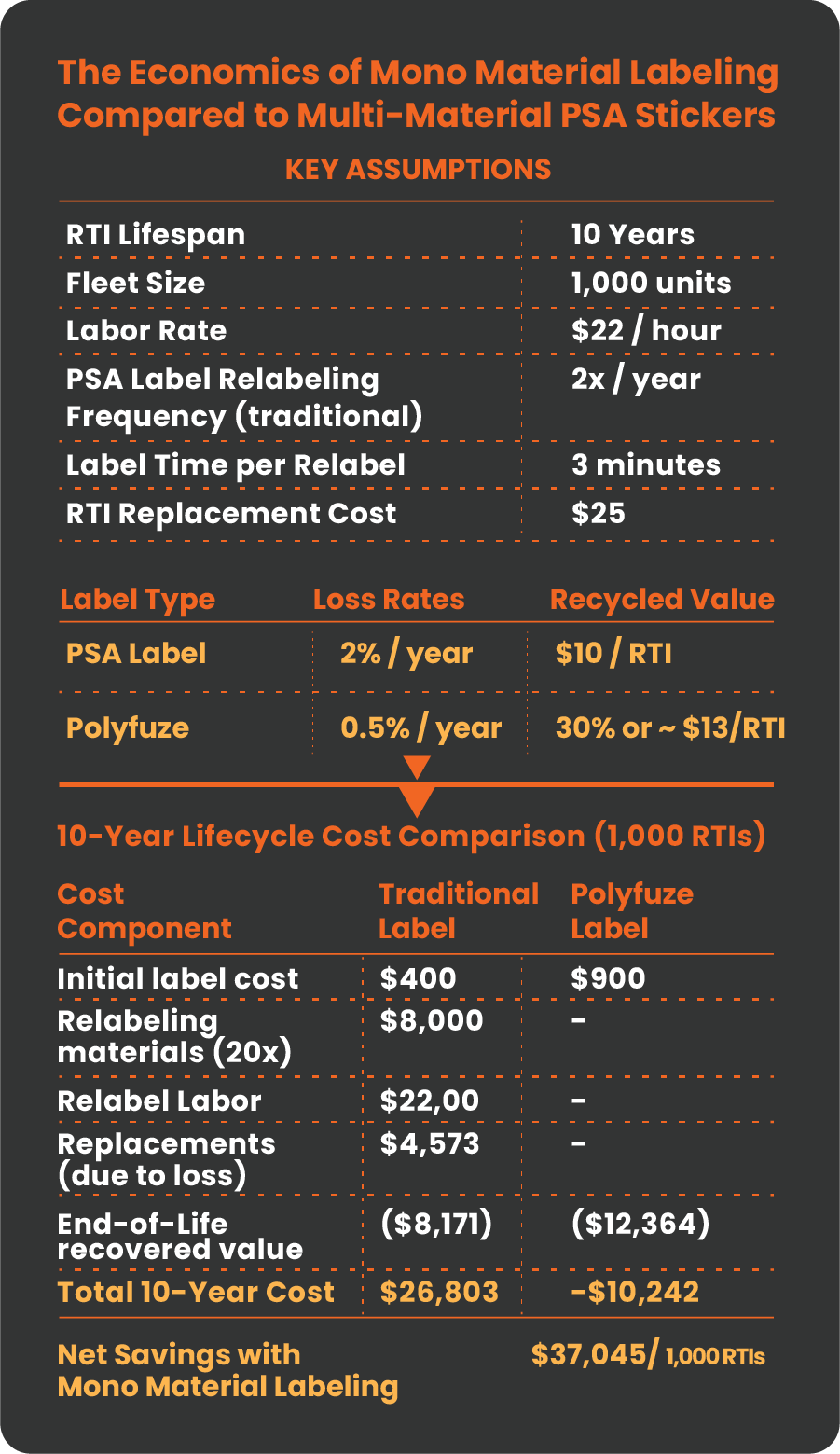
Pooling companies and retailers see the world in cycles — reuse cycles, cleaning cycles, replacement cycles. When a mono material label costs more upfront than a pressure-sensitive sticker, the instinct is to hesitate.
But the calculus changes over time. A label that never peels, never needs replacement, and remains readable for thousands of turns flips the cost equation from expense per use to investment per asset. The winners will be those who look beyond the first invoice to the lifetime ledger. A traditional label will be replaced 3-5 times per year. The Total Cost of Ownership model is obvious.
Traditional Label Makers — Still a Place, Different Purpose
This evolution doesn’t erase traditional labeling. There will always be short-term use cases, temporary logistics tags, and non-polyolefin surfaces where adhesives make sense. Mono material labeling doesn’t replace; it redefines the frontier, where permanence, durability, and circularity intersect. In every industrial revolution, the familiar survives, just in a narrower lane.
Regulators – The Tailwind of Change
While markets hesitate, regulation accelerates. Extended Producer Responsibility, PPWR mandates, and global Design for Recyclability frameworks all point toward one direction: simpler, purer material streams. For policymakers, mono material labeling isn’t a niche innovation — it’s the logical endpoint of their own circular economy goals.
Regulatory momentum will do what markets alone rarely can: make change inevitable.
The Pattern of Progress
Every innovative shift follows the same pattern. Hotels didn’t invite Airbnb to the table. Nokia didn’t foresee the phone as PC. Before they were replaced, all category leaders believed their system was stable and would stand the test of time – until innovation designed a better system.
Mono material labeling introduces that same logic into the world of plastic identification. Initially, it appears costly and complex. Upon deeper evaluation, however, its many benefits are obvious.
“When a better way fits the physics of the future, the market always catches up.”
Completing the Evolution – From Decoration to Integration
For half a century, labeling meant attaching information to plastic. Now it means integrating identity within plastic.
Each generation of labeling reflected the limits of its era:
- Adhesives answered speed.
- In-mold labels answered aesthetics.
- Digital printing answered personalization.
- Mono-material labeling answers circularity — the defining challenge of this one.
It doesn’t reject the past. It completes it.
A natural progression from surface decoration to material integration, from information that sits on plastic to identity that lives within it
A New Category, by Design
The world doesn’t need another label. It needs a new relationship between label and plastic. One built for infinite reuse and complete recyclability. Mono Material Labeling is that relationship. It is not a better version of what came before; it is a fundamentally different way to think about what a label is.
As categories go, this one starts small, a handful of innovators, engineers, and sustainability leaders rethinking how information travels with plastic. But it grows fast, because its logic is simple:
If plastic is meant to live again, shouldn’t its label live with it?
About Polyfuze
Polyfuze’s revolutionary Mono Material labeling technology represents a major breakthrough in sustainable industrial packaging. Unlike traditional labels that use incompatible materials and adhesives, Polyfuze permanently fuses branding, barcodes, RFID and compliance information directly into the surface of polyolefin products like HDPE and PP.
The result is a label that never peels, fades, or contaminates the recycling stream—ensuring full compatibility with closed-loop and circular economy goals.
Engineered for demanding use cases such as pallets, totes, crates, and IBCs, Polyfuze empowers OEMs and end users to meet rising sustainability standards without sacrificing durability, traceability, or performance. As the only labeling solution of its kind, Polyfuze is redefining what’s possible in recyclable, reusable packaging.
Established in 1983, we bring over four decades of expertise in plastics labeling and graphics. Our founder’s entrepreneurial spirit remains a driving force in our culture, fueling a commitment to innovation that begins with listening closely to our customers.