


Case Study.
Graphics Designed for
Extreme Outdoor Conditions
Designing Identity That Lasts as Long as
the Product It Protects
Executive Summary
A global automotive manufacturer faced a persistent issue with safety labeling on interior and component surfaces, specifically in environments exposed to chemicals such as sunscreen, insect repellent, and human contact. GM has an expectation that a part label last 15 years, the life expectancy of the product.
While most labels passed initial validation, they degraded over time.
Not immediately. Not visibly at first. But predictably.
The challenge was not compliance at installation; it was compliance over time.
By transitioning to material-integrated identity, the organization achieved life-of-vehicle durability across [6.5M+] components, aligning safety information with the lifecycle of the product itself. Polyfuze was the only label supplier to qualify.
1. Why Extreme Environments Reveal the Weakest Layer First
Industrial equipment built for outdoor environments operates in conditions most products never experience.
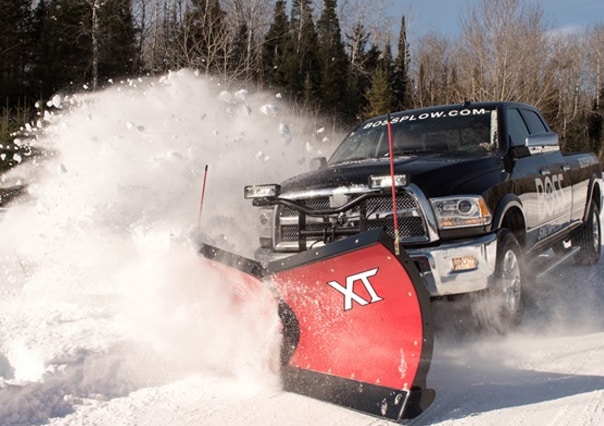
Snowplows push through freezing rain, packed snow, road salt, and continuous abrasion for entire winter seasons. Agricultural equipment spends years exposed to UV radiation, chemicals, mud, vibration, and impact. Snowblowers, tractors, utility equipment, and tracked vehicles routinely operate in environments where temperatures can fall well below -40°F while surfaces endure constant mechanical and environmental stress.
Manufacturers engineer these products specifically to survive those realities. But historically, the identity systems attached to them were engineered very differently.
For BOSS Snowplows and other manufacturers operating in extreme outdoor environments, traditional labels and branding systems repeatedly failed long before the products themselves showed meaningful wear. Logos faded. Edges peeled. Graphics disappeared under freeze-thaw cycles, salt exposure, abrasion, and repeated cleaning.
The equipment continued performing exactly as designed. The identity attached to it did not.
2. The Environment Is the Product Test
Outdoor industrial equipment does not operate in controlled environments. The environment itself becomes part of the engineering challenge.
Snowplows and winter equipment routinely encounter:
- sub-zero temperatures
- freeze-thaw cycling
- road salt and de-icing chemicals
- continuous abrasion from snow and ice
- moisture intrusion
- impact and vibration
- UV exposure during off season storage
These are not occasional stress events. They are normal operating conditions. And over time, those environments expose weaknesses quickly, especially in surface-applied graphics systems.
Traditional labels often fail gradually at first. Colors fade. Corners begin lifting. Adhesives weaken under thermal cycling and chemical exposure. Eventually, logos, safety markings, and product identification begin disappearing entirely from equipment still fully operational in the field.
The product survives. The communication layer does not.
The Reality of Outdoor Equipment Environments
Outdoor equipment routinely experiences:
- freeze-thaw cycles
- road salt exposure
- UV radiation
- abrasion from snow, ice, dirt, and debris
- pressure washing
- vibration and impact
- extreme temperature swings
Most surface-applied graphics systems are not engineered for that lifecycle reality.
3. The Material Shift That Changed Everything
Historically, this problem was less visible because industrial equipment relied heavily on painted metals and high-surface-energy materials. Metal accepts labels relatively well.
Modern outdoor equipment increasingly does not.
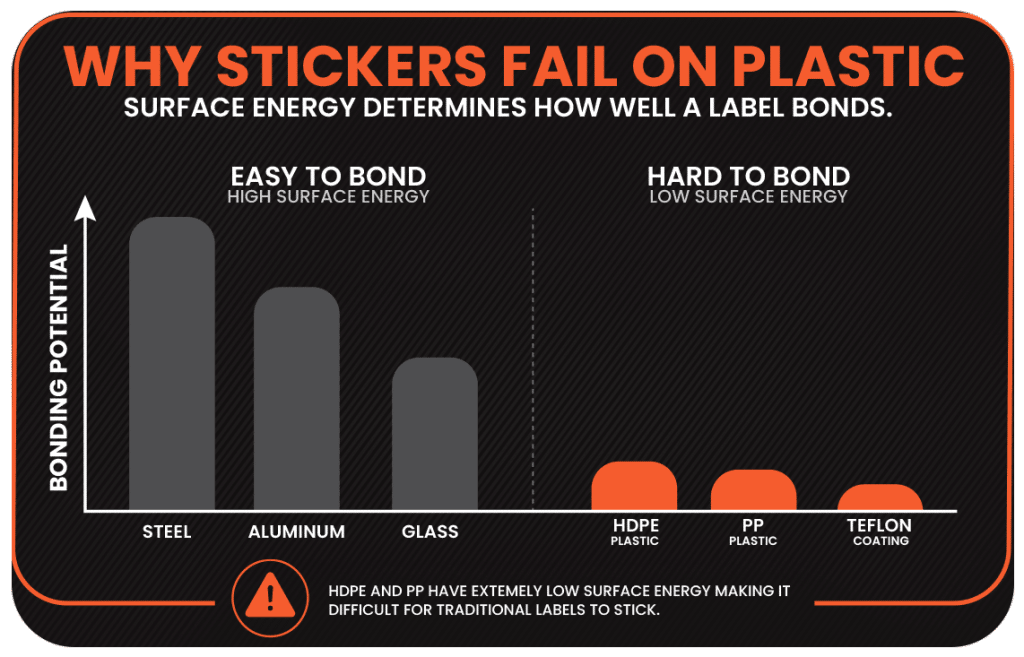
Manufacturers have shifted toward engineered plastics such as HDPE, polypropylene, TPO, and structural polymers because they provide superior impact resistance, corrosion resistance, weight reduction, and environmental durability compared to traditional metal systems.
But these materials introduce a different challenge: they resist adhesion by design.
Low-surface-energy plastics make traditional labels, inks, and surface graphics inherently unstable over long operational lifecycles. To compensate, manufacturers often rely on flame treatment, aggressive adhesives, or secondary surface preparation processes that themselves degrade under harsh environmental exposure.
The result is a structural mismatch between: the durability expectations of the product and the durability limitations of the identity system attached to it.
The harsher the environment becomes, the more visible that mismatch becomes over time.
4. Removing the Failure Interface
Rather than attempting to reinforce traditional labels, BOSS pursued a different approach entirely.
Using heat and pressure, Polyfuze permanently fused branding and graphics directly into the polymer structure of the product itself. Instead of sitting on the surface as a separate layer, the identity became integrated into the material.
That distinction fundamentally changed the failure profile of the system. Because the graphics became part of the polymer structure:
- no adhesive layer remained
- no edge lift could occur
- no secondary interface existed to fail under environmental stress
The identity system now aged alongside the product itself rather than independently from it.
In practical terms, the branding began surviving the same environments the equipment was originally engineered to endure.
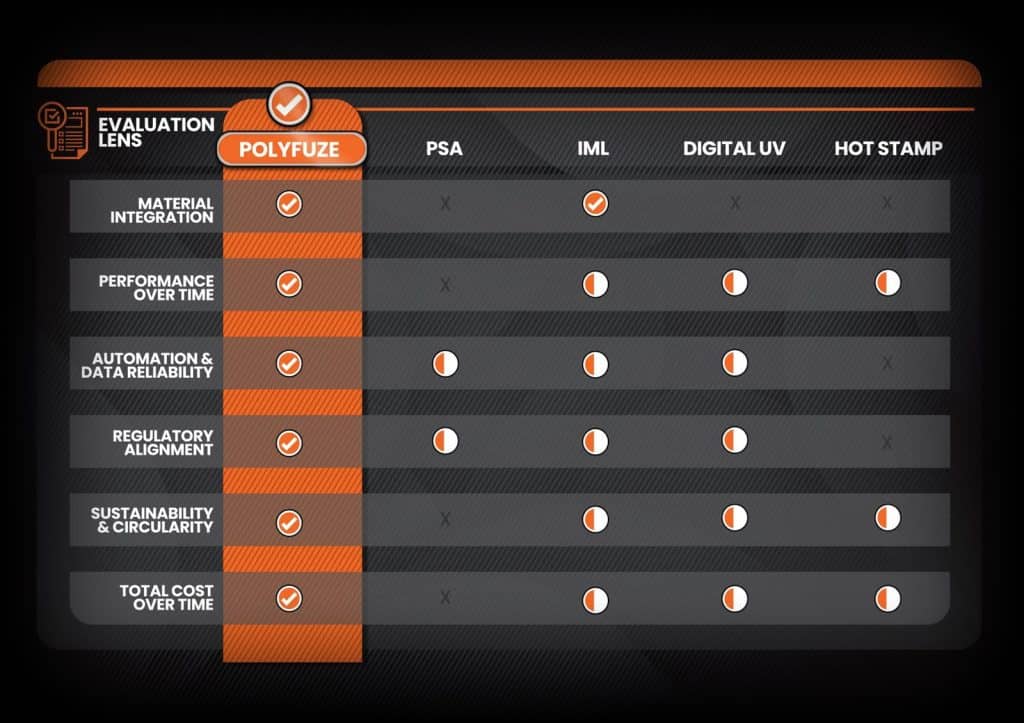
5. Label Comparison
For industrial manufacturers, graphics degradation creates more than cosmetic issues.
Field appearance directly affects brand perception, equipment value perception, and customer confidence in product durability. Products that continue functioning mechanically but appear visually degraded can unintentionally communicate reduced quality long before the equipment itself reaches end of life.
Operationally, traditional labels also introduce recurring costs tied to:
- relabeling
- field replacement
- warranty concerns
- production complexity
- pre-treatment requirements
- quality-control variability
By integrating identity directly into the material structure, manufacturers reduced many of those downstream issues while improving long-term visual consistency across products operating in harsh environments.
The result was not simply improved label durability. It was alignment between product engineering and identity engineering.
6. The Larger Industry Insight
Extreme environments do not create failure. They reveal incompatibility.
This case highlights a broader shift occurring across industrial manufacturing: products evolved materially while many identity systems did not evolve alongside them.
As manufacturers increasingly adopt engineered plastics for outdoor durability, corrosion resistance, and lifecycle performance, identity systems designed for painted metal assumptions begin failing structurally over time.
That is not a branding problem.It is a materials problem.
And increasingly, it is becoming a systems-engineering problem as well.
Because if identity cannot survive the environment the product was specifically engineered to endure, then the identity system was never truly part of the product architecture in the first place.
Estimate Your Avoidable
Labeling Costs
See how label failure, replacement, and labor costs add up over time.

About Polyfuze
Polyfuze’s revolutionary Mono Material labeling technology represents a major breakthrough in sustainable industrial packaging. Unlike traditional labels that use incompatible materials and adhesives, Polyfuze permanently fuses branding, barcodes, RFID and compliance information directly into the surface of polyolefin products like HDPE and PP.
The result is a label that never peels, fades, or contaminates the recycling stream—ensuring full compatibility with closed-loop and circular economy goals.
Engineered for demanding use cases such as pallets, totes, crates, and IBCs, Polyfuze empowers OEMs and end users to meet rising sustainability standards without sacrificing durability, traceability, or performance. As the only labeling solution of its kind, Polyfuze is redefining what’s possible in recyclable, reusable packaging.
Established in 1983, we bring over four decades of expertise in plastics labeling and graphics. Our founder’s entrepreneurial spirit remains a driving force in our culture, fueling a commitment to innovation that begins with listening closely to our customers.
Tell us about your application and we’ll help you determine if Polyfuze is the right fit.
We’ll review:
- Material compatibility
- Labeling method
- Volume and scale
- Implementation approach