


Case Study.
When the Interface Fails,
the Product Feels Broken
Why Products Built for Abuse Still Carry
Fragile Identity Systems
1. Why Durable Appliances Still Depend on Fragile Communication Systems
Modern appliances are engineered to survive years of demanding daily use. Dishwashers in particular operate in environments defined by heat, steam, detergents, moisture, and constant interaction cycles. Internal systems are carefully designed around long-term durability expectations because consumers expect premium appliances to perform reliably for years.
But for one global appliance manufacturer, a recurring problem continued appearing long before the mechanical systems failed. The interface degraded first.
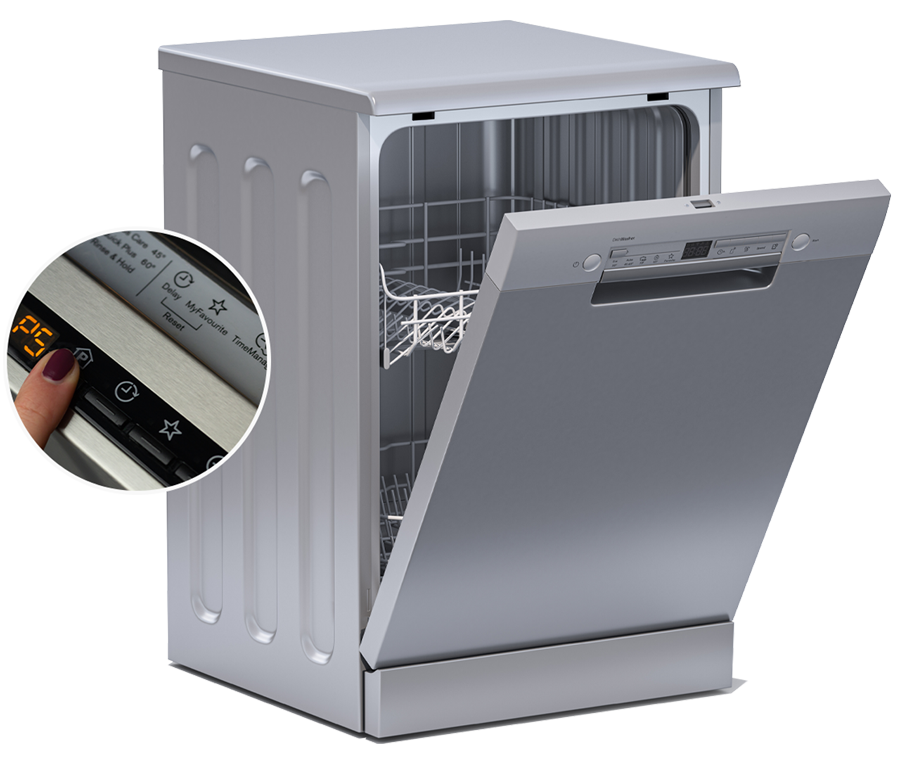
Control panel graphics exposed to repeated cleaning, moisture, detergent exposure, and constant user interaction gradually faded, peeled, or wore away over time. Buttons remained functional, but the product slowly lost its ability to clearly communicate with the user.
The dishwasher still operated. But the experience surrounding it deteriorated.
For premium appliances, that distinction matters. Consumers often judge product quality not only by whether the machine functions, but by whether the interaction experience still feels durable years after purchase.
2. The Most Important Surface on the Product
For most consumers, the control panel is the product.
It is the surface users interact with every day to select cycles, configure settings, and operate the appliance itself. The interface carries a disproportionate share of the customer experience because it becomes the primary point of communication between the user and the machine.
When that communication layer begins degrading, the perception of the entire product changes.
Icons become difficult to read. Settings lose clarity. Surfaces appear worn or damaged. Even when the internal systems continue performing normally, the appliance itself begins feeling older, lower quality, or less reliable to the user.
The issue is subtle at first. But over years of repeated interaction, the degradation compounds.
3. Why Traditional Labels Failed
The operating environment of a modern dishwasher is exceptionally aggressive for traditional surface graphics systems. Control panels are routinely exposed to:
- steam and humidity
- detergents and cleaning chemicals
- temperature cycling
- repeated physical interaction
- abrasion from daily use
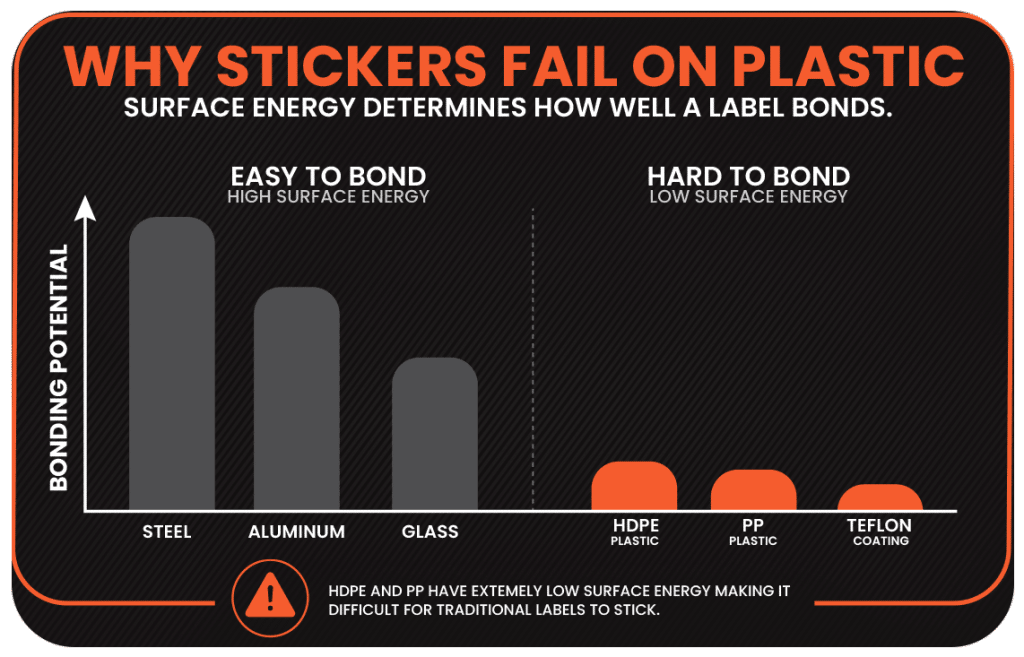
Most traditional labels and printed graphics degrade under these conditions over time, particularly when applied to low-surface-energy plastics such as polypropylene.
That material creates an additional engineering challenge. Polypropylene performs exceptionally well in appliance environments because it resists heat, moisture, and chemicals. But those same properties make it notoriously difficult for traditional labels and inks to bond with reliably over long operational lifecycles.
The result is a structural mismatch: the appliance surface is engineered for durability while the communication layer attached to it often is not.
4. Protecting the Interface From the Environment
Rather than continuing to expose graphics directly to the abuse environment, the manufacturer pursued a fundamentally different approach.
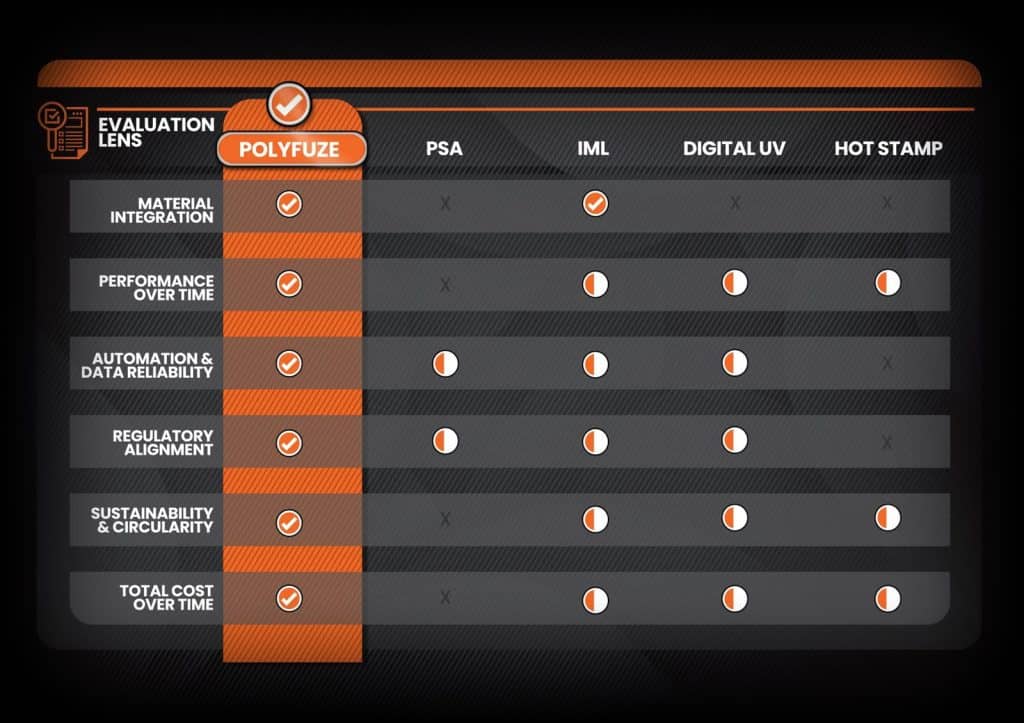
Using heat and pressure, Polyfuze permanently fused graphics into the material structure itself, allowing branding and interface graphics to be applied beneath the surface rather than sitting exposed on top of it.
That distinction significantly changed the durability profile of the interface. Because the graphics became integrated into the material system itself:
- there was no adhesive layer to degrade
- no surface-applied graphics to wear away
- no exposed interface vulnerable to steam, detergents, or abrasion
The communication layer was now protected inside the structure of the component itself.
As a result, the interface maintained long-term legibility and visual consistency across years of real-world appliance use.
5. The Economics of Interface Durability
In consumer products, interface degradation creates costs that extend beyond replacement or warranty concerns.
When controls wear prematurely, consumers often associate the visible degradation with broader product quality issues, even when the appliance itself continues operating normally. That perception can influence customer satisfaction, product reviews, warranty interactions, and long-term brand trust.
Operationally, traditional graphics systems also introduce recurring manufacturing and quality-control challenges tied to adhesion consistency, durability performance, and lifecycle appearance standards.
By integrating graphics directly into the material structure, the manufacturer improved:
- long-term interface clarity
- resistance to steam and chemical exposure
- product appearance consistency
- perceived product durability
- premium brand presentation over time
The result was not simply a more durable graphic system. It was a more durable customer experience.
6. The Larger Industry Insight
Products are rarely judged solely by their internal engineering.They are judged through moments of interaction.
Consumers may never see the motor, pump, or internal mechanical systems inside an appliance. But they interact with the interface constantly. When that interface degrades, the entire product experience begins degrading alongside it.
This case highlights a broader issue across durable consumer products: communication systems often age differently than the products they are attached to.
As products become more premium and lifecycle expectations continue extending, manufacturers will increasingly need identity and interface systems capable of surviving the same environments as the products themselves.
Because when the interface fails, the product feels broken — even when it technically still works.
Why Dishwasher Environments Destroy Traditional Graphics
Dishwasher control panels experience:
- continuous steam exposure
- detergents and chemical cleaners
- repeated moisture cycling
- elevated temperatures
- constant physical interaction
Few traditional graphics systems are engineered for that level of long-term environmental exposure.
The Psychology of Product Durability
Consumers often evaluate product quality visually long before mechanical failure occurs. Worn interfaces, faded controls, and degraded graphics can reduce perceived product quality even when internal systems continue functioning normally.
7. What This Reveals
Products are tested in laboratories. Identity systems are tested in reality.
Products are judged in moments of interaction. Not in specifications. Not in testing. But in use.
And when the interface degrades: The product feels broken—even when it isn’t.
This case highlights a broader truth: Identity is not just informational.
It is experiential.
And when it fails: The experience fails with it.
Estimate Your Avoidable
Labeling Costs
See how label failure, replacement, and labor costs add up over time.

About Polyfuze
Polyfuze’s revolutionary Mono Material labeling technology represents a major breakthrough in sustainable industrial packaging. Unlike traditional labels that use incompatible materials and adhesives, Polyfuze permanently fuses branding, barcodes, RFID and compliance information directly into the surface of polyolefin products like HDPE and PP.
The result is a label that never peels, fades, or contaminates the recycling stream—ensuring full compatibility with closed-loop and circular economy goals.
Engineered for demanding use cases such as pallets, totes, crates, and IBCs, Polyfuze empowers OEMs and end users to meet rising sustainability standards without sacrificing durability, traceability, or performance. As the only labeling solution of its kind, Polyfuze is redefining what’s possible in recyclable, reusable packaging.
Established in 1983, we bring over four decades of expertise in plastics labeling and graphics. Our founder’s entrepreneurial spirit remains a driving force in our culture, fueling a commitment to innovation that begins with listening closely to our customers.
Tell us about your application and we’ll help you determine if Polyfuze is the right fit.
We’ll review:
- Material compatibility
- Labeling method
- Volume and scale
- Implementation approach