
How It Works & The Science of
Mono Material
Labeling Technology
Forming a permanent molecular bond between label and plastic.
How It Works & The Science for
Mono Material
Labeling Technology
Polyfuze Technology enables mono material labeling by forming a permanent molecular bond between label and plastic.
How It Works
Pressure + Heat = Permanence
Polyfuze permanently integrates labeling directly into your polyolefin product.
1. PRESSURE
Pressure: aligning materials
Pressure ensures full, uniform contact between activated surfaces, so polymer chains can interlock consistently across every cycle.
2. HEAT
Heat: Activating the Polymer.
Precise heat softens compatible polyolefin materials at the interface. This allows polymer chains to mobilize without degrading the base material. Temperature control is critical, too little and integration fails, too much and material properties are compromised.
3. PERMANENCE
Permanence: Becoming One Material System.
As the material cools, the integrated structure stabilizes into a single mono-material component. There is no adhesive layer to fail, no edge to lift, and no interface to degrade. Identity becomes inseparable from the plastic itself.
Will Mono Material Labeling
Work For Me?
Will Mono Material
Labeling Work For Me
Most labels solve the problem of attachment. Polyfuze solves the problem of material compatibility. Instead of using glue to bond dissimilar materials together, Polyfuze integrates identification into the plastic itself using heat and pressure.
Most labels solve the problem of attachment. Polyfuze solves the problem of material compatibility. Instead of using glue to bond dissimilar materials together, Polyfuze integrates identification into the plastic itself using heat and pressure.

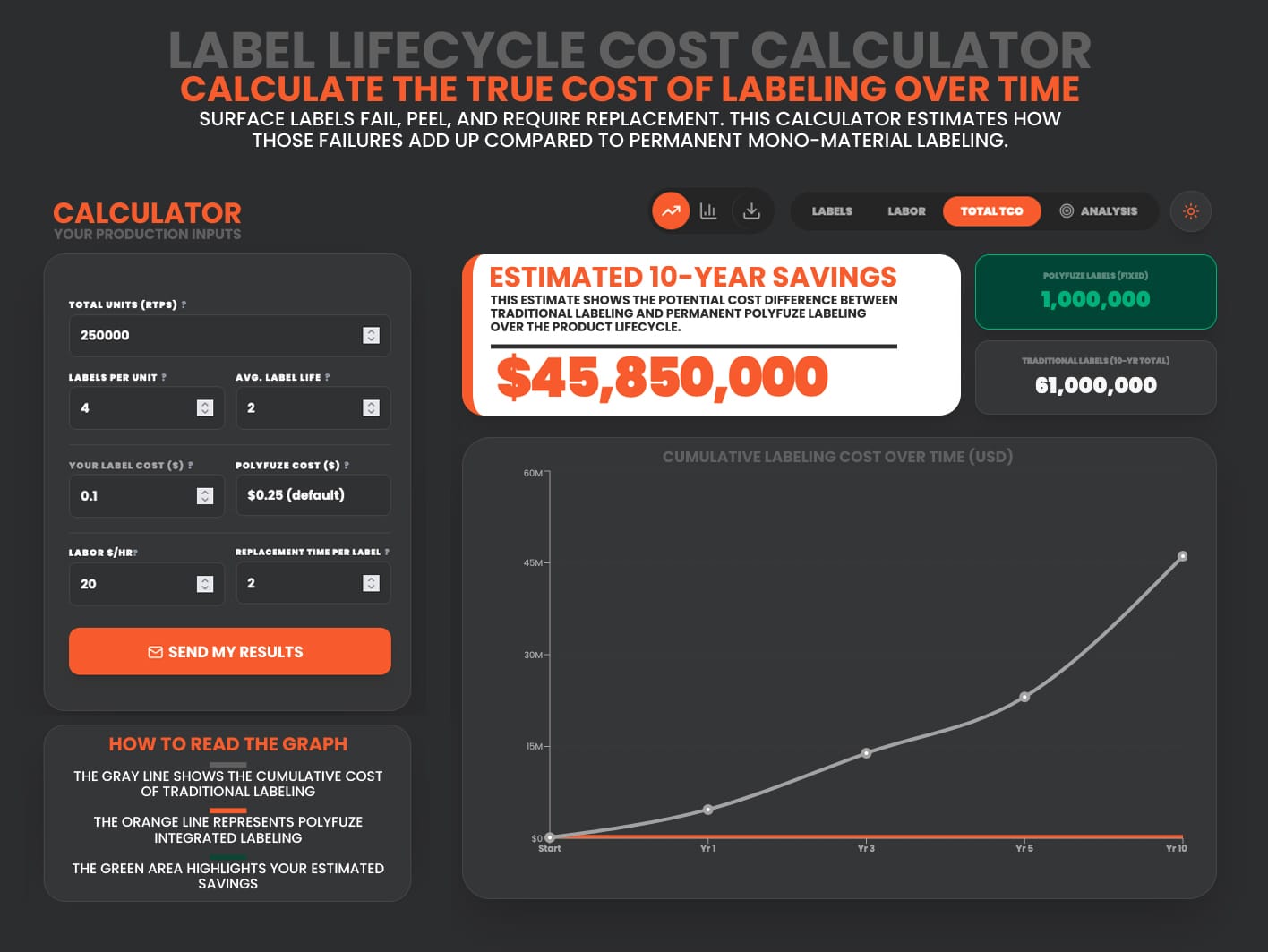
Estimate Your Avoidable
Labeling Costs
See how label failure, replacement, and labor costs add up over time.
Adjust a few inputs to generate a 10-year cost range and compare traditional labeling with fixed Polyfuze performance.
Time Is The Real Label Test
How Labeling Technologies Perform Over Time
Why material integration outperforms surface attachment.
When you compare labels the way systems actually use them, mono material labeling pulls ahead fast. Pressure-sensitive, in-mold, and hot-stamp labels cling to the surface and slowly fall apart under heat, abrasion, and regulation, while mono-material labeling becomes part of the plastic itself.
Proof of Performance
Measured down to the molecular level
SEM analysis confirmed no discrete adhesion layer in Polyfuze samples, versus visible adhesive layers in PSA, hot stamp, and IML — a key failure point under chemical and environmental stress.
Material of the Month
Material of the
Month
Thermoplastic Polyolefin (TPO)
This Month: Thermoplastic
Polyolefin (TPO)
Thermoplastic Polyolefin (TPO) is widely used in durable products because it combines the toughness of polypropylene with elastomeric flexibility. It performs well in heat, cold, and outdoor environments.
Thermoplastic Polyolefin (TPO) is widely used in durable products because it combines the toughness of polypropylene with elastomeric flexibility. It performs well in heat, cold, and outdoor environments.
Rethinking ASTM
D3359 for Plastic Identity
When a 1974 Test Meets a 2026 Labeling Problem. ASTM D3359 was created in 1974 to measure how well coatings adhere to metal substrates.
Rethinking ASTM
D3359 for Plastic Identity
When a 1974 Test Meets a 2026 Labeling Problem. ASTM D3359 was created in 1974 to measure how well coatings adhere to metal substrates.
When a 1974 Test Meets a 2026 Labeling Problem. ASTM D3359 was created in 1974 to measure how well coatings adhere to metal substrates.