


Case Study.
When Identity Enters the Human Body,
Failure Is No Longer Acceptable
How Customization, Compliance, and Durability
Collide in Dental Devices
1. How Dental Device Manufacturers Are Rethinking Identity, Hygiene, and Bio-compatibility
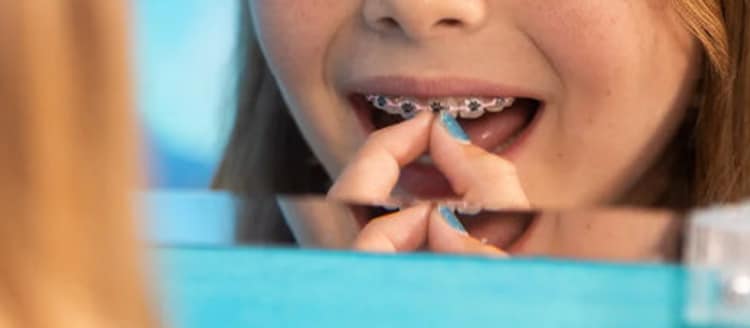
Customization is rapidly reshaping the dental industry. Orthodontic appliances, retainers, aligners, and specialty dental devices are increasingly designed around individual patients, creating new opportunities for personalization, serial numbers, and workflow efficiency.
But customization introduces a challenge many manufacturers were not originally designed to solve: graphics must now operate inside the human body.
That changes the requirements entirely.
Traditional labels and surface markings routinely failed under intraoral conditions involving constant moisture exposure, mechanical abrasion, cleaning cycles, and biological contact. More importantly, they introduced additional material interfaces into environments where safety, hygiene, and biocompatibility are tightly regulated.
The issue was no longer simply durability. The identity layer itself had become part of the biological system surrounding the product.
2. The Hidden Challenge Behind Customization
As dental devices become more customized, manufacturers face growing pressure to maintain reliable identification throughout the product lifecycle. Patient-specific workflows increasingly depend on accurate product traceability for manufacturing, handling, compliance, and clinical use.
Historically, most identity systems were treated as secondary surface applications — labels, markings, or printed layers added after the product itself was complete.
That assumption becomes problematic when the product enters the human body.
Dental devices operate in one of the most demanding environments possible for traditional surface graphics. Constant moisture exposure, repeated cleaning, temperature fluctuation, saliva, abrasion, and biological interaction all accelerate degradation over time.
For conventional labels and markings, failure becomes difficult to avoid.
3. Why Traditional Graphic Systems Failed
Most traditional labeling systems were never designed for long-term intraoral use.
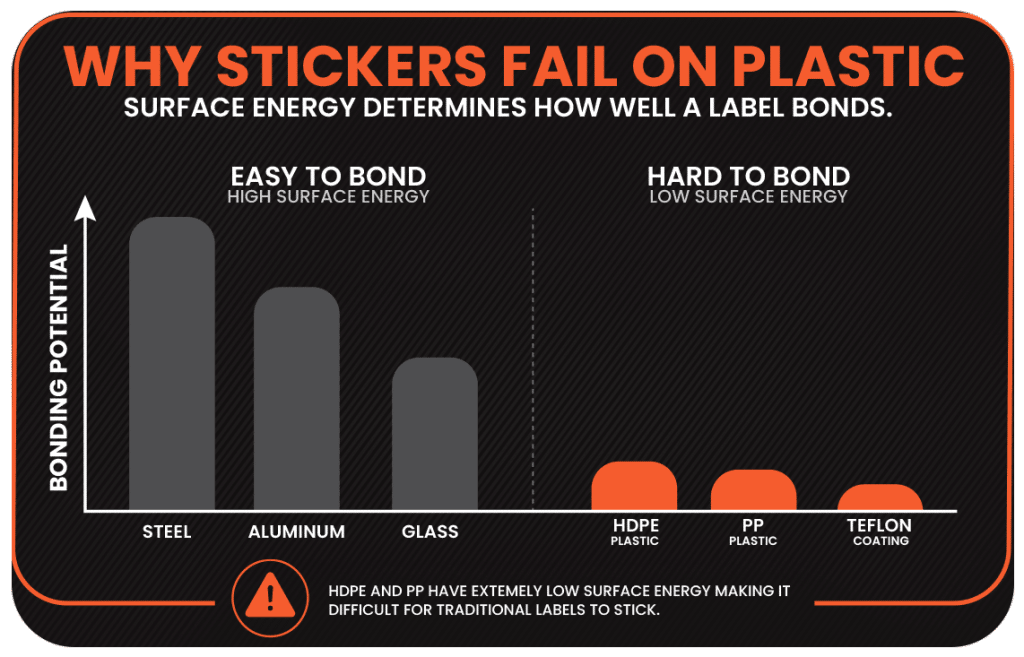
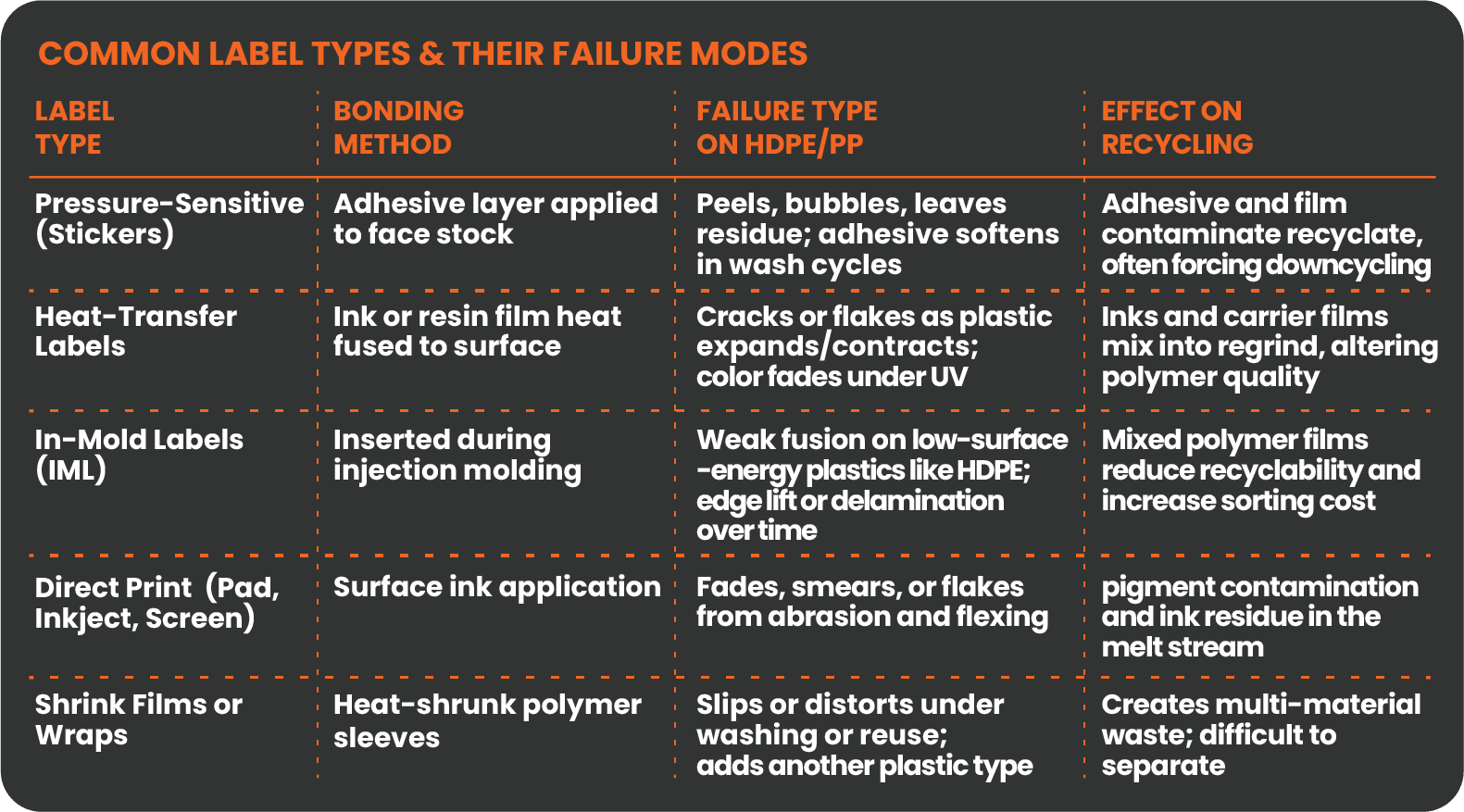
Adhesive-based constructions and surface-applied graphics introduce additional materials, interfaces, and degradation pathways into highly regulated biological environments. Over time, repeated exposure to moisture and abrasion weakens those systems, creating risks that extend beyond simple appearance or readability issues.
As surface layers begin degrading, manufacturers face multiple concerns simultaneously:
- loss of product identification
- compromised aesthetics
- material breakdown
- potential chemical exposure
- increased hygiene and contamination risk
The core problem was structural.
The dental device itself was engineered to meet strict biological and regulatory requirements, while the identity layer attached to it often was not.
That creates a critical mismatch inside highly controlled medical environments.
4. Identity as Part of the Material System
Rather than improving the label itself, the manufacturer pursued a different approach entirely: eliminating the label layer altogether.
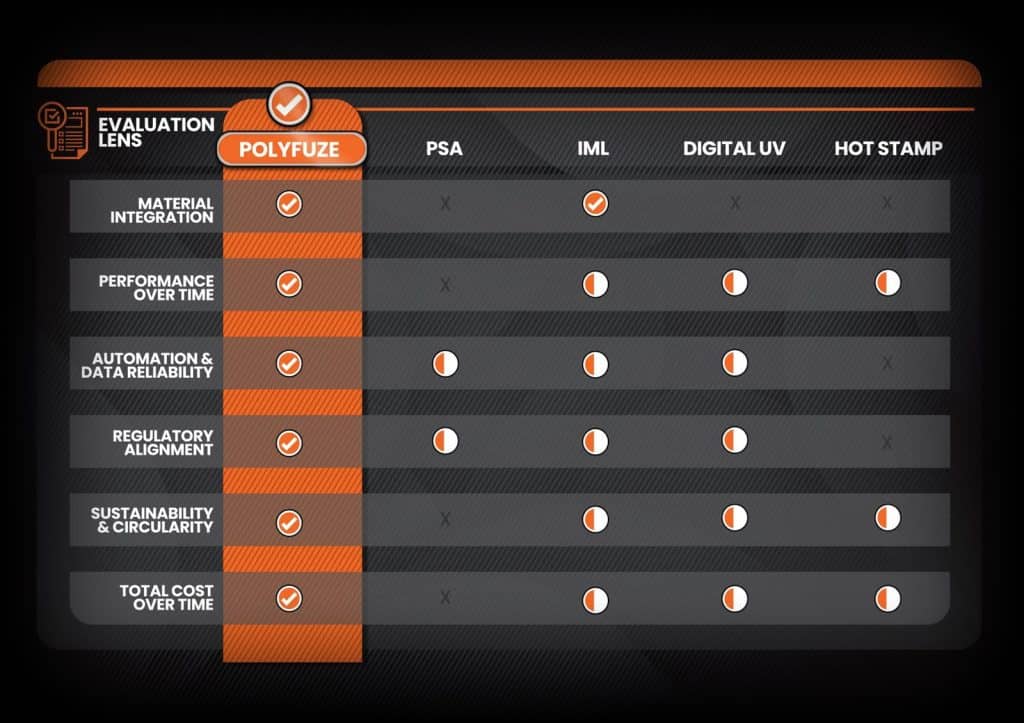
Using heat and pressure, Polyfuze permanently fused graphics directly into the polyolefin substrate, creating a mono-material structure integrated into the device itself rather than applied onto the surface afterward.
Because the identity became part of the material structure, the system eliminated many of the traditional failure points associated with surface-applied graphics:
- no adhesive layer
- no edge lift
- no secondary material interface
- no separate degradation pathway
Equally important, the graphic system aligned with the biological requirements of the application itself.

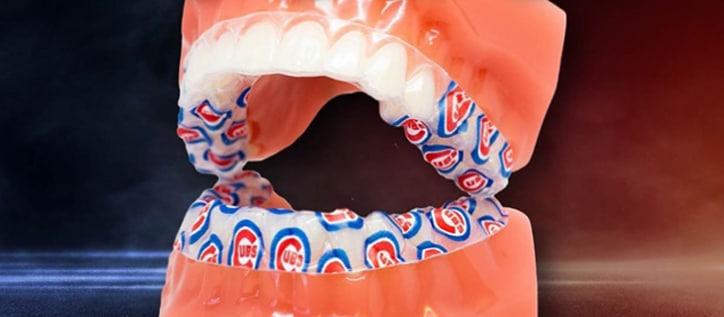
The resulting structure successfully met ISO 10993 biocompatibility requirements, including non-cytotoxicity, irritation, and sensitization testing standards associated with intraoral medical applications.
Graphics were no longer treated as a separate cosmetic layer. It became part of the product’s material system.
5. The Operational and Commercial Impact
For dental manufacturers, identity durability affects far more than product appearance.
Reliable identification improves traceability, supports regulatory workflows, simplifies patient-specific customization, and reduces operational inconsistency throughout manufacturing and clinical use. As customization scales, durable identity systems become increasingly important to maintaining efficiency across individualized product environments.
By integrating identity directly into the material structure, the manufacturer achieved:
- persistent product identification
- compliance alignment for intraoral use
- reduced degradation risk
- improved lifecycle durability
- scalable customization support
The result was not simply a more durable marking system. It was a more stable product architecture for personalized healthcare applications.
ISO 10993 and Identity Systems
ISO 10993 evaluates the biological safety of materials used in medical devices, including cytotoxicity, irritation, and sensitization risks. As identity systems become integrated into patient-contact products, those systems increasingly inherit the same compliance expectations as the device itself.
6. The Larger Industry Insight
As medical and dental products become increasingly customized, graphics can no longer operate outside the regulatory and biological expectations of the product itself.
Historically, manufacturers viewed graphics as a secondary graphics decision.
But once products enter regulated biological environments, every material interface matters.
This case demonstrated a broader shift occurring across healthcare manufacturing: identity systems must now satisfy the same expectations for durability, hygiene, and biocompatibility as the products they identify.
Durability alone is no longer sufficient. Identity must also be biologically compatible, operationally stable, and effectively invisible within the performance of the product itself.
Estimate Your Avoidable
Labeling Costs
See how label failure, replacement, and labor costs add up over time.

Industry Leaders Choose The Polyfuze Advantage































About Polyfuze
Polyfuze’s revolutionary Mono Material labeling technology represents a major breakthrough in sustainable industrial packaging. Unlike traditional labels that use incompatible materials and adhesives, Polyfuze permanently fuses branding, barcodes, RFID and compliance information directly into the surface of polyolefin products like HDPE and PP.
The result is a label that never peels, fades, or contaminates the recycling stream—ensuring full compatibility with closed-loop and circular economy goals.
Engineered for demanding use cases such as pallets, totes, crates, and IBCs, Polyfuze empowers OEMs and end users to meet rising sustainability standards without sacrificing durability, traceability, or performance. As the only labeling solution of its kind, Polyfuze is redefining what’s possible in recyclable, reusable packaging.
Established in 1983, we bring over four decades of expertise in plastics labeling and graphics. Our founder’s entrepreneurial spirit remains a driving force in our culture, fueling a commitment to innovation that begins with listening closely to our customers.
Tell us about your application and we’ll help you determine if Polyfuze is the right fit.
We’ll review:
- Material compatibility
- Labeling method
- Volume and scale
- Implementation approach