


Case Study.
When Labels Become
a Contamination Vector
Why Identity Failure in Healthcare Systems Is Not Just
Operational. It’s Biological.
Executive Summary
Healthcare waste systems are designed around containment, traceability, and infection control. Every component within the system is engineered to survive repeated exposure to harsh cleaning protocols, chemical sanitization, and regulated handling environments.
But one component consistently failed. The label.
A global medical waste management provider began experiencing recurring barcode degradation and label failure on reusable healthcare containers operating within repeated sterilization workflows. Initially, the issue appeared operational: labels peeled, tracking accuracy declined, and relabeling created additional labor and process interruptions.
Over time, however, the organization identified a more serious concern.
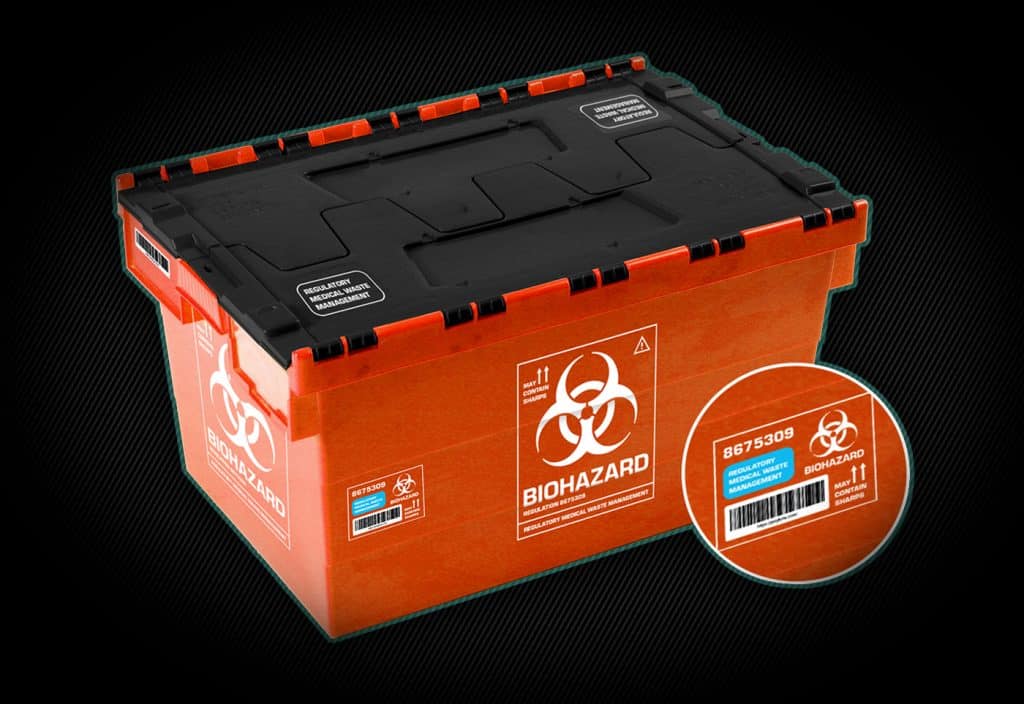
As labels lifted from the container surface, exposed edges and adhesive interfaces created areas where moisture, debris, and microbial contamination could persist. The identification layer itself had become inconsistent with the hygiene requirements of the system surrounding it.
The issue was no longer simply durability. It was contamination control.
1. The Hidden Weakness in
Sterile Systems
Modern healthcare logistics systems are built on predictability. Containers move through tightly controlled cycles of handling, sanitization, transport, and redistribution. Surfaces are repeatedly pressure washed, chemically treated, and exposed to aggressive cleaning environments designed to eliminate biological risk.
The containers themselves are engineered accordingly. Most are manufactured from durable polyolefin materials selected specifically for their chemical resistance, long service life, and compatibility with repeated sterilization.
Traditional labels are not.
Most identification systems still rely on layered adhesive constructions originally designed for packaging applications with dramatically shorter lifecycle expectations. Under repeated sanitization cycles, those systems begin degrading in highly predictable ways. Edges lift. Adhesives weaken. Surface layers break down under abrasion and chemical exposure.
In healthcare environments, those failures create more than appearance issues. They introduce physical interfaces where contamination can accumulate and persist.
That creates a structural contradiction inside the system itself: a sterile workflow dependent on a non-sterile identity layer.
2. Why Traditional Identity Systems Failed
The underlying issue was material incompatibility.
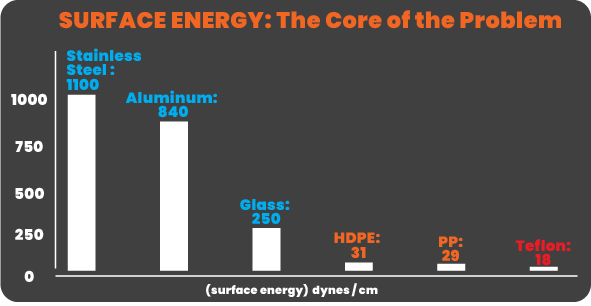
Low-surface-energy plastics such as polypropylene and HDPE are intentionally designed to resist adhesion, making them ideal for reusable medical containers but problematic for conventional labels. Over time, the mismatch between the substrate and the adhesive layer becomes increasingly unstable under harsh cleaning conditions.
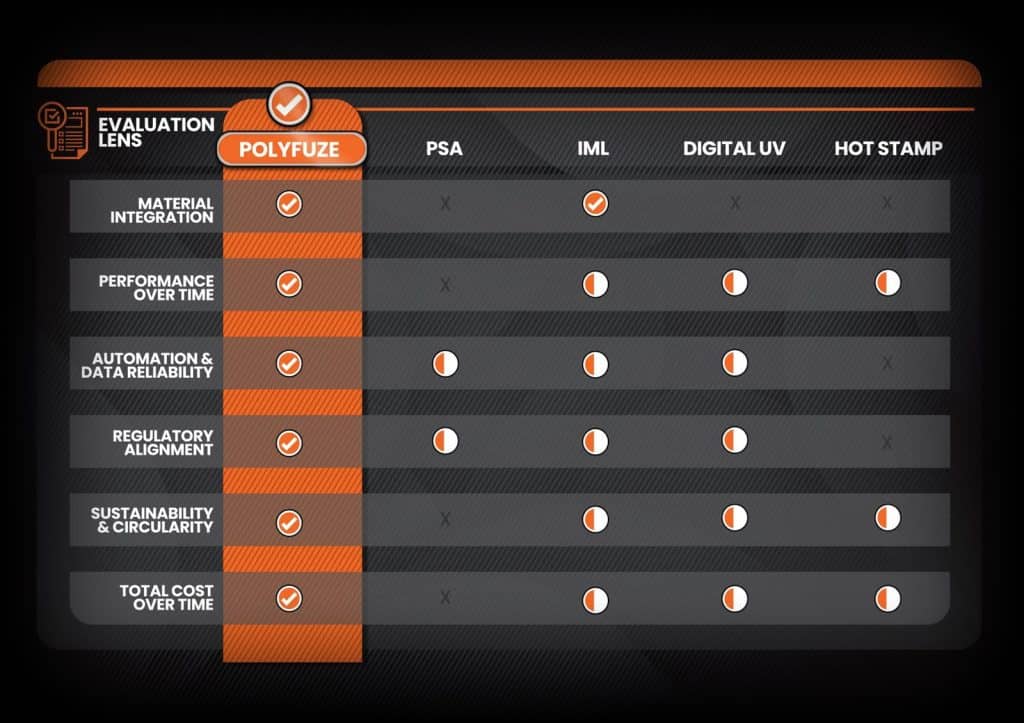
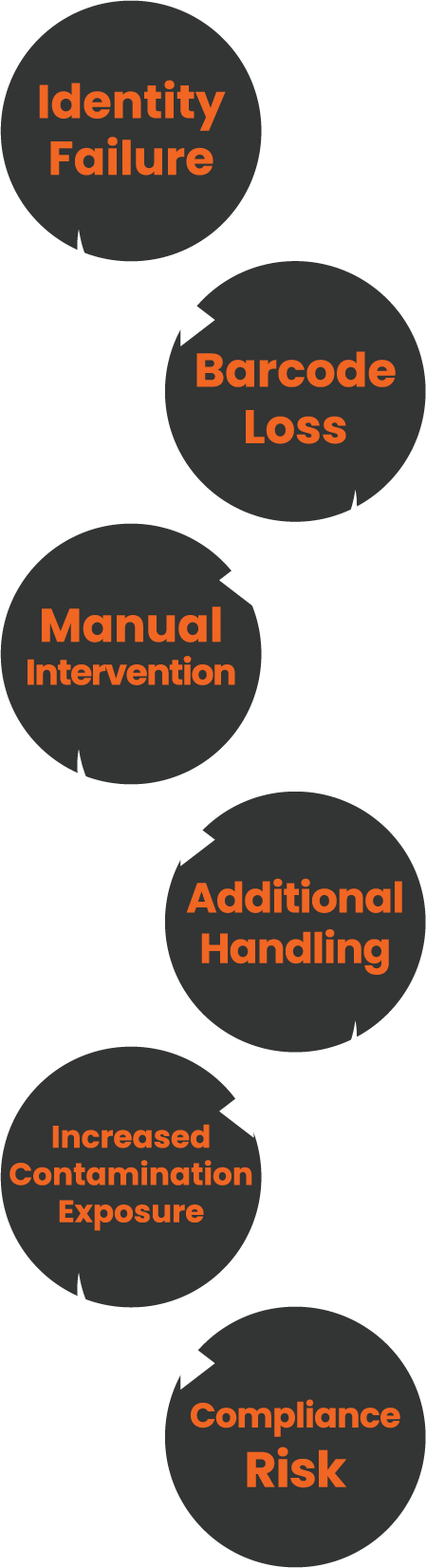
The result is a gradual failure cycle:
- label edge lift
- adhesive exposure
- barcode degradation
- repeated relabeling
- increased manual intervention
- growing contamination risk
What appeared initially as a maintenance issue was ultimately a system design issue. The identity layer was aging differently than the container itself.
3. Redefining Identity for Reusable Healthcare Systems
The solution required eliminating the failure interface altogether.
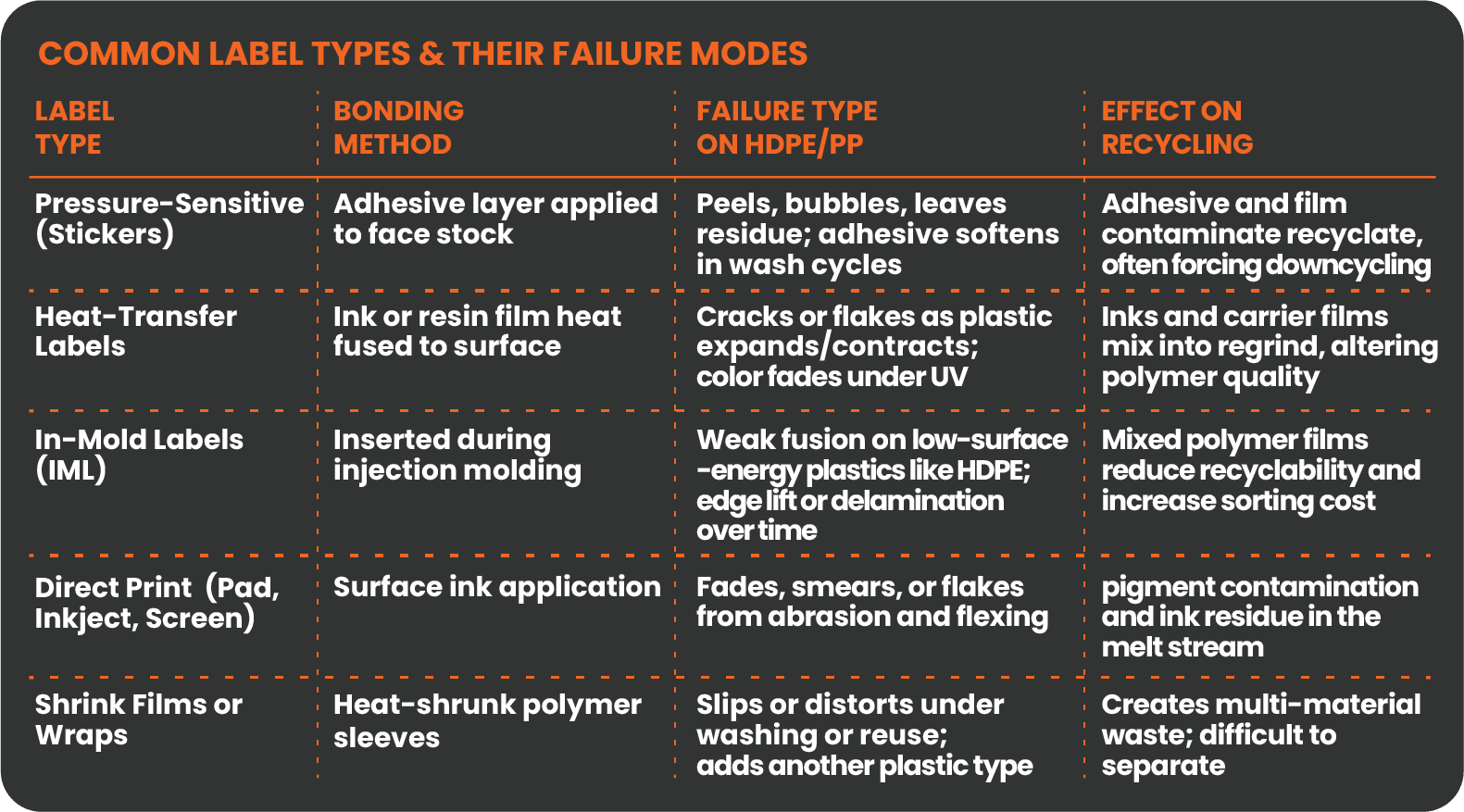
Rather than applying a separate label onto the container surface, Polyfuze permanently fused the identity layer into the polymer substrate using heat and pressure. The result was a mono-material structure integrated directly into the container itself.
Because no adhesive layer remained, there were no exposed edges to lift, trap debris, or degrade under sanitization exposure. Barcode readability remained stable across repeated cleaning cycles while the container maintained a smooth, sealed surface profile aligned with infection control requirements.
Identity was no longer treated as a temporary surface application. It became part of the container structure itself.
4. The Economics of Identity Failure
In healthcare systems, relabeling costs extend far beyond the replacement value of the label.
Every failure event introduces additional labor, workflow interruption, compliance exposure, and traceability risk. Containers removed from circulation for relabeling reduce operational efficiency while increasing handling requirements inside already constrained healthcare logistics environments.
More importantly, contamination-related risk carries downstream implications that are difficult to measure purely through direct replacement costs.
When identity systems degrade, organizations begin losing both visibility and environmental control simultaneously.
By aligning identity durability with container durability, the organization reduced manual intervention requirements, improved long-term barcode consistency, and eliminated recurring failure points associated with adhesive-based labeling systems.
The operational result was not simply improved durability. It was improved system stability.
5. The Larger Operational Insight
Healthcare systems tolerate very little uncontrolled risk.Yet most reusable healthcare containers still rely on identity technologies originally designed for temporary packaging environments.
This case demonstrated a broader industry reality: when identity systems fail inside regulated environments, the consequences extend beyond tracking and operational inconvenience. They begin affecting hygiene performance, contamination control, and system reliability itself.
As reusable healthcare systems continue expanding, identity durability will increasingly become part of infection-control design — not merely a labeling decision.
Industry Leaders Choose The Polyfuze Advantage































About Polyfuze
Polyfuze’s revolutionary Mono Material labeling technology represents a major breakthrough in sustainable industrial packaging. Unlike traditional labels that use incompatible materials and adhesives, Polyfuze permanently fuses branding, barcodes, RFID and compliance information directly into the surface of polyolefin products like HDPE and PP.
The result is a label that never peels, fades, or contaminates the recycling stream—ensuring full compatibility with closed-loop and circular economy goals.
Engineered for demanding use cases such as pallets, totes, crates, and IBCs, Polyfuze empowers OEMs and end users to meet rising sustainability standards without sacrificing durability, traceability, or performance. As the only labeling solution of its kind, Polyfuze is redefining what’s possible in recyclable, reusable packaging.
Established in 1983, we bring over four decades of expertise in plastics labeling and graphics. Our founder’s entrepreneurial spirit remains a driving force in our culture, fueling a commitment to innovation that begins with listening closely to our customers.
Tell us about your application and we’ll help you determine if Polyfuze is the right fit.
We’ll review:
- Material compatibility
- Labeling method
- Volume and scale
- Implementation approach