
How to Determine Your Supply Chain Identity Technology
Why Choosing the Right System Matters More Than Ever—
and How to Get It Right
For most of modern supply chain history, identity was treated as a detail.
Products needed labels. Labels carried barcodes. Barcodes were scanned. Systems updated. The process worked well enough, and because it worked well enough, it was rarely questioned.
The label was not strategic. It was operational. That assumption is now breaking.
Over the past decade, supply chains have undergone a quiet but profound shift. The cost of track-and-trace systems has collapsed. What was once economically viable only for pharmaceuticals, aerospace components, and other high-value assets is now deployable across everyday operations—reusable packaging, work-in-process inventory, and mid-value goods that move continuously through complex networks.
At the same time, the systems consuming identity have evolved. Warehouses have become automated environments. Data platforms have become central nervous systems. Digital twins promise real-time visibility into physical operations. Standards like GS1 Digital Link have expanded what a simple scan can represent.
In other words, the modern supply chain is no longer constrained by the ability to track.
It is constrained by whether what it tracks remains true.
And that brings us to a new kind of decision, one that many organizations are not yet equipped to make.
Not what label to use. But what identity system to design.
1. The Mistake Most Teams Make
When organizations begin evaluating track-and-trace solutions today, the conversation often starts in the wrong place. It starts with technology. Should we use RFID? Should we upgrade to QR codes? Should we build toward a digital twin?
These are not unimportant questions. But they are downstream questions. They assume something that has not yet been validated that the identity layer itself will survive long enough for any of those technologies to matter.
This is the quiet failure point in many modern systems.
Teams invest in increasingly sophisticated methods of reading identity, transmitting identity, and analyzing identity. But far less attention is paid to whether that identity will still exist physically, reliably, and continuously after months or years of real-world operation.
The result is a new kind of system failure. Not one that announces itself.
But one that gradually separates what the system believes from what is actually happening.
2. The First Decision Is Not the Technology
Before choosing a labeling format, a scanning method, or a tracking platform, there is a more fundamental decision to make.
What type of identity system are you building?
Most identity technologies fall into one of three broad categories.
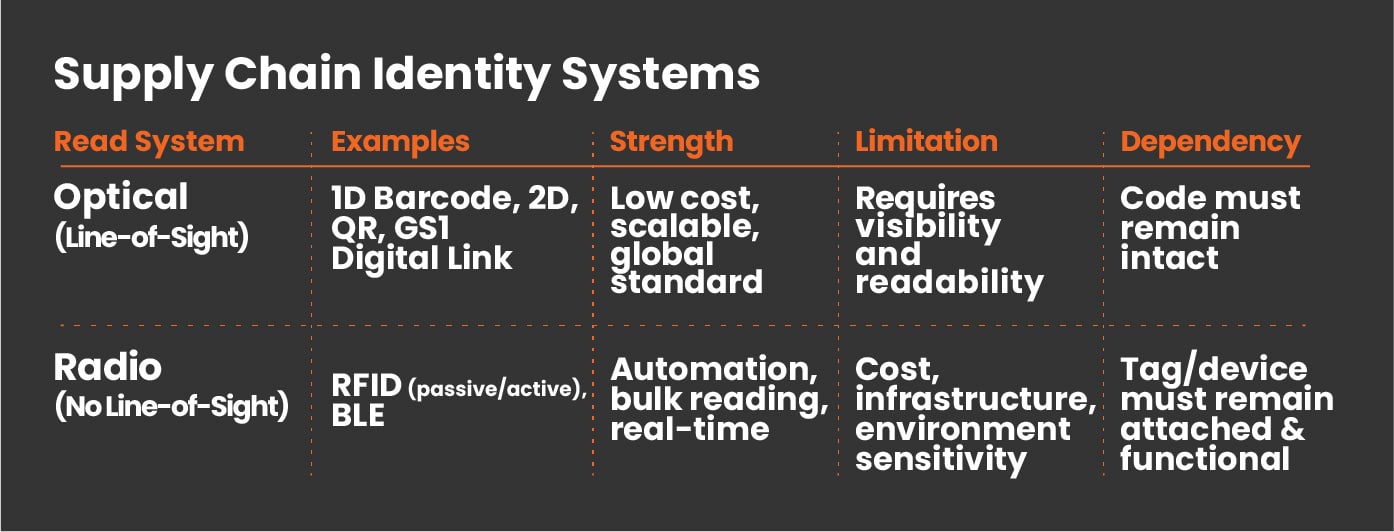
The first is optical identity—barcodes, QR codes, and GS1-based systems. These rely on visual recognition. They are inexpensive, scalable, and globally standardized. For many applications, they remain the most practical solution.
The second is radio-based identity—RFID and BLE systems that transmit information wirelessly. These enable automation at scale, allowing assets to be identified without direct line of sight.
The third is integrated identity—systems in which identity is embedded into the material itself, rather than applied to it. This includes laser marking and mono material approaches, where the identifier is engineered to persist as long as the asset it represents.
Each of these categories has strengths. Each has limitations. And importantly, each depends on a shared assumption:
That the identity remains intact.
This is the point that is most often overlooked. Before deciding how to read identity, you must decide whether identity will survive.
3. Why Optical Systems Dominate and Where They Break
For most organizations, the decision will still point toward optical systems. QR codes and GS1 standards are becoming increasingly powerful. They can carry more data, connect to digital systems, and scale across global supply chains with minimal friction.
In theory, they are an ideal solution. In practice, they introduce a quiet dependency.
They work perfectly—until they don’t.
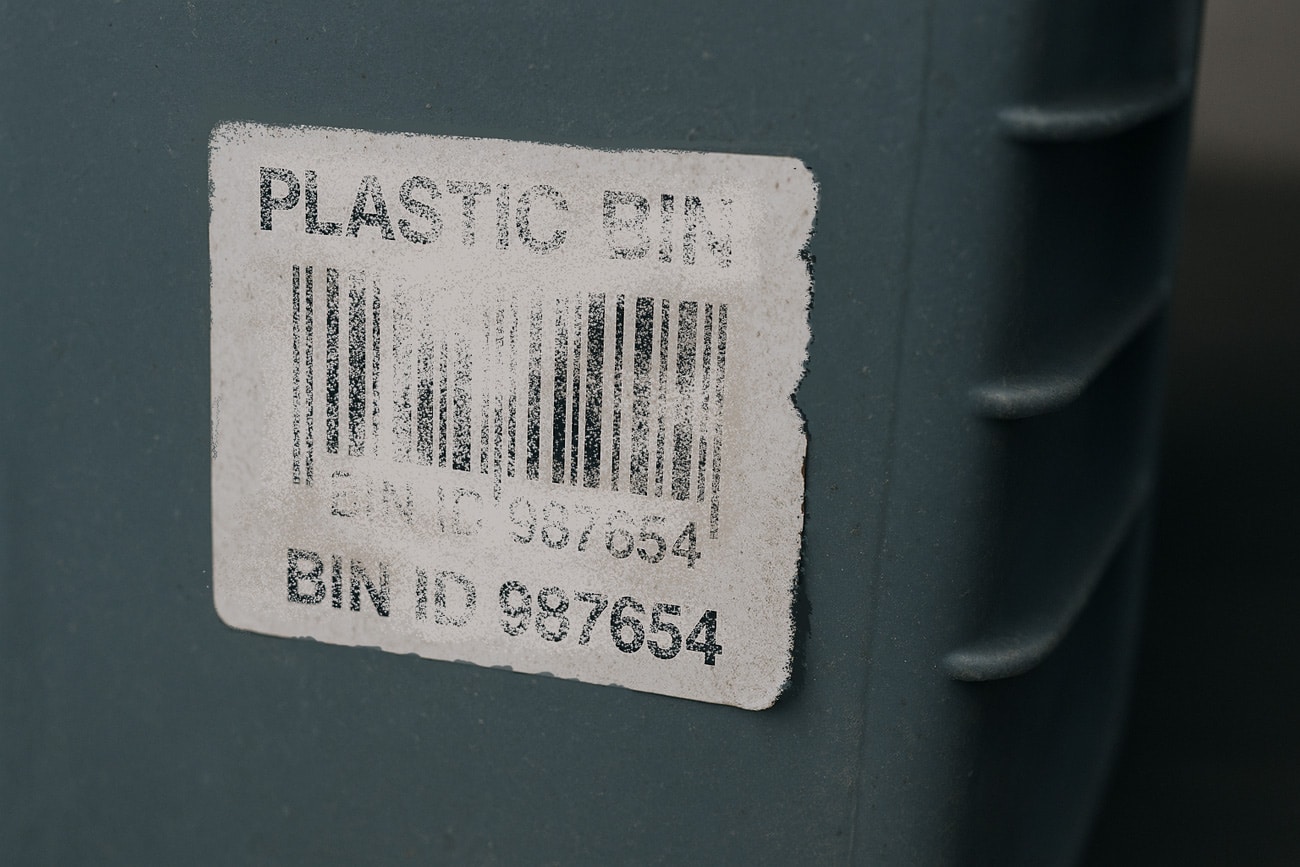
The failure is rarely immediate. A code does not simply disappear overnight. Instead, it degrades. A small abrasion here. A wash cycle there. A slight distortion that causes a missed scan. Then another. Then a workaround.
The system compensates. And because the system compensates, the problem goes unnoticed.
Until it accumulates. Like the quote from The Sun Also Rises, “How did you go bankrupt? Two ways. Gradually and then suddenly”
4. Designing Identity for the Conditions It Must Survive
If optical identity is chosen, the next step is not implementation. It is design.
Specifically, design for the conditions the identity must survive, not the conditions under which it is applied.
This requires stepping back from the label itself and examining the environment.
- How long will the asset exist?
- What will it encounter along the way?
- Who—or what—will need to read it?
These questions are deceptively simple. But they define whether an identity system will succeed or fail.
Consider lifecycle first. A shipping label that needs to survive three days is fundamentally different from an identifier that must remain readable across three years of reuse. When the asset outlives the identifier, the outcome is predictable. The system will lose track, not because the asset disappeared, but because its identity did.
Then consider environment. Supply chains are not static. They involve movement, handling, exposure. Labels encounter abrasion from conveyors, chemicals from cleaning processes, UV from outdoor storage, and mechanical stress from automation. Most identity systems are not designed for these realities. They are designed for application, not operation.
Automation introduces another layer of constraint. Humans can compensate for degraded identity. Machines cannot. A code that is “mostly readable” to a person is often completely invisible to a scanner or vision system. As automation increases, tolerance for degradation decreases.
And finally, consider persistence. Modern supply chains are no longer linear. Assets circulate. They return. They are reused. Every time identity must be reapplied, there is a break in continuity—a moment where the system must re-establish truth. Over time, these moments accumulate into inconsistency.
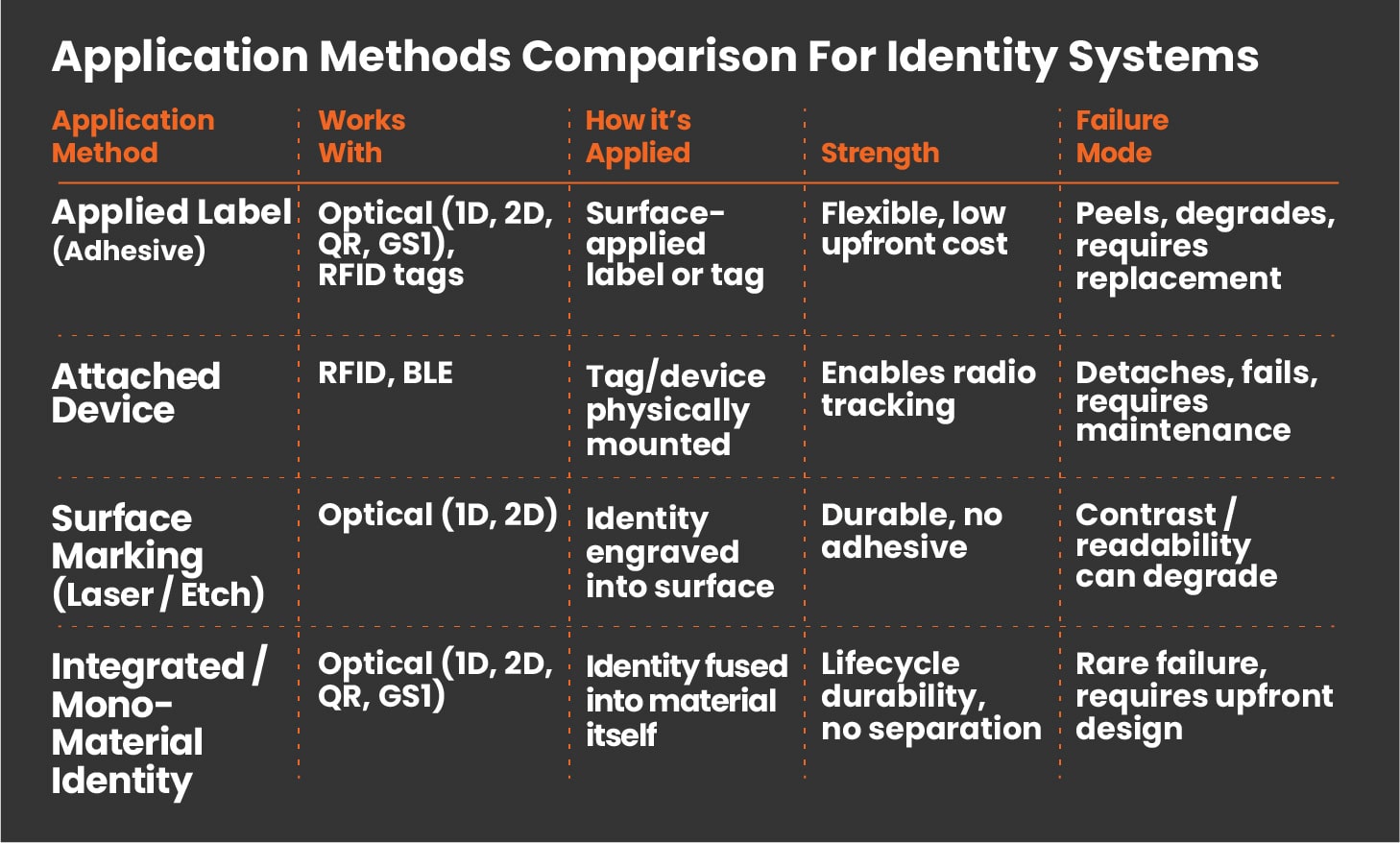
Mono-material identity is not a competing technology to QR, 2D, or GS1.
It is a different way of applying those same identity systems—one designed to ensure they survive the full lifecycle of the asset.
5. When the System Looks Right But Isn’t
If these factors are not aligned, something subtle happens.
The system continues to operate. Data continues to flow. Dashboards continue to update. Digital twins continue to represent the system.
But the connection between the physical world and the digital one begins to loosen. This is not failure in the traditional sense. There is no obvious breakdown. Instead, there is drift.
An asset moves without being registered. A location remains “confirmed” longer than it should. A system begins relying on last-known truth instead of current reality. The more sophisticated the system, the more convincing this state becomes.
It is entirely possible, and increasingly common, for a supply chain to appear highly functional while being quietly misaligned.
6. The Structural Decision: Applied vs. Integrated Identity
At some point, the design conversation becomes unavoidable.
If identity must persist; across time, environment, and system complexity—can it remain something that is applied?
Traditional labeling assumes that identity is a layer added to the surface of an asset. That layer is, by definition, separate from the material it is attached to. It can degrade independently. It can fail independently. And when it does, the system must compensate.
An alternative approach is to align identity with the material itself.
In integrated systems, identity is not applied it is built into the asset. It is designed to endure the same lifecycle, the same environmental exposure, and the same operational stresses.
This does not eliminate all challenges. But it removes one of the most common failure points: the separation between the asset and its identity.
Approaches such as those developed by Polyfuze follow this philosophy. Rather than improving the durability of a label, they eliminate the need for the label to behave as a separate component. Identity becomes part of the asset’s structure.
The implication is larger than it may appear. When identity persists, systems stabilize.
Not because they have more data, but because the data remains anchored to reality.
THERE IS ALWAYS A PHYSICAL INTERFACE
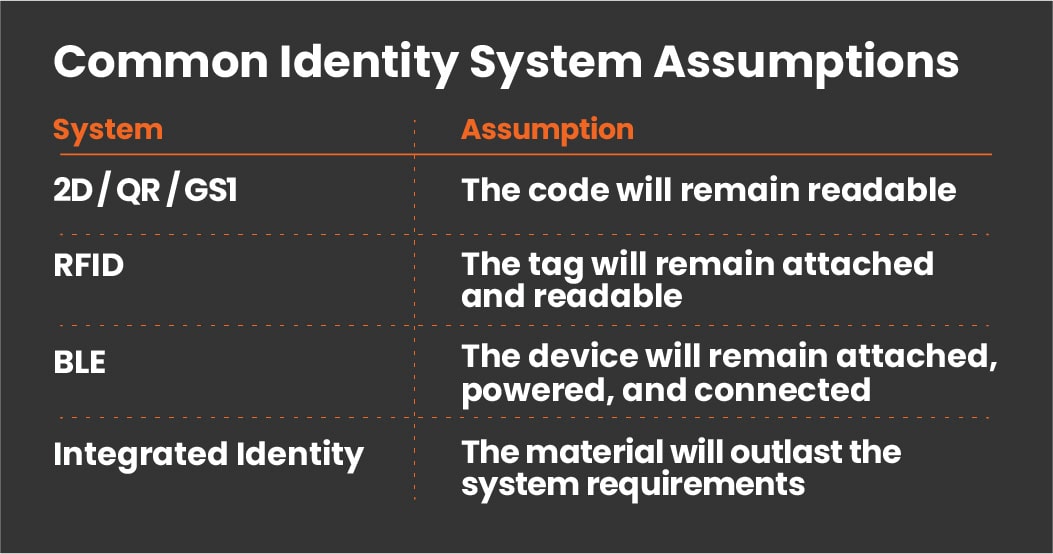
This distinction is often missed in technology discussions. Teams compare QR codes to RFID, or GS1 standards to BLE systems, as if they are interchangeable choices. In reality, these are methods of reading identity, not methods of preserving it.
Every identity system—whether optical or radio-based—depends on a physical interface. A barcode must remain visible. An RFID tag must remain attached. A BLE device must remain powered and functional. When that interface fails, the system does not immediately break. It simply stops updating reliably.
What appears to be a technology decision is, in practice, a materials and durability decision.
7. Designing for the Worst Day, Not the Best
The temptation in modern system design is to optimize for capability.
What is the most advanced technology available? What can we deploy? What can we scale? Why not? The cost of supply chain technology has dropped like a 50” TV.
But supply chains are not defined by their best day. They are defined by their worst one.
The system that performs perfectly in controlled conditions but degrades under stress is not a robust system. It is a fragile one with a convincing demonstration.
The systems that endure are those designed for the conditions that are hardest to control—the abrasion, the wash cycles, the repeated handling, the passage of time.
Identity must be designed for those conditions. Because everything else depends on it.
8. The Real Question
By the time an organization reaches the end of this decision process, the original question—what technology should we use—begins to feel incomplete.
The better question is: What identity system will still be working when everything else is stressed?
That question does not have a universal answer. Different environments will lead to different decisions. Optical systems will continue to play a central role. RFID and BLE will expand in the right contexts. Integrated identity will become more important as reuse and circularity increase. But across all of these, one principle holds.
The system is only as reliable as the identity it depends on.
And increasingly, that identity must satisfy a second requirement. It must not compromise the material system it is attached to.
As supply chains move toward reusable packaging, circular logistics, and regulatory frameworks like EPR and digital product passports, identity is no longer just a data layer. It becomes part of the material lifecycle. This is where most traditional approaches begin to break down.
Applied labels introduce foreign materials. Adhesives complicate recycling streams. RFID tags add multi-material complexity. Even when they function operationally, they often create friction at end-of-life.
This is why mono-material identity approaches, such as those developed by Polyfuze, represent a different design philosophy. Not just more durable identity. But compatible identity. Identity that behaves as part of the product, not as an exception to it.
The implication is larger than it first appears. In a circular system, the label cannot be an afterthought. Because anything that must be removed, replaced, or separated introduces cost, labor, and risk.
“If identity has to be removed to recycle the asset, it was never designed for the system.”































Conclusion
Modern supply chains do not suffer from a lack of technology.
They suffer from misalignment between what systems expect and what identity can sustain. As tracking becomes easier, cheaper, and more widespread, this misalignment becomes more consequential—not less.
Because the systems will continue to operate. They will continue to produce data. They will continue to look correct. The only question is whether that data still reflects reality.
And that begins with choosing an identity system designed not for convenience, but for survival.
About Polyfuze
Polyfuze’s revolutionary Mono Material labeling technology represents a major breakthrough in sustainable industrial packaging. Unlike traditional labels that use incompatible materials and adhesives, Polyfuze permanently fuses branding, barcodes, RFID and compliance information directly into the surface of polyolefin products like HDPE and PP.
The result is a label that never peels, fades, or contaminates the recycling stream—ensuring full compatibility with closed-loop and circular economy goals.
Engineered for demanding use cases such as pallets, totes, crates, and IBCs, Polyfuze empowers OEMs and end users to meet rising sustainability standards without sacrificing durability, traceability, or performance. As the only labeling solution of its kind, Polyfuze is redefining what’s possible in recyclable, reusable packaging.
Established in 1983, we bring over four decades of expertise in plastics labeling and graphics. Our founder’s entrepreneurial spirit remains a driving force in our culture, fueling a commitment to innovation that begins with listening closely to our customers.
Tell us about your application and we’ll help you determine if Polyfuze is the right fit.
We’ll review:
- Material compatibility
- Labeling method
- Volume and scale
- Implementation approach