Traditional labeling systems apply identity to the surface. Polyfuze enables product identity at the material level.
The Illusion of Performance
The Illusion of Performance
At Installation, most labeling technologies appear equivalent
At Installation, most labeling technologies appear equivalent
Labels live in dynamic systems where time, stress, and material behavior expose weaknesses that aren’t visible on day one. The problem isn’t initial performance. It’s performance over time.
Labels live in dynamic systems where time, stress, and material behavior expose weaknesses that aren’t visible on day one. The problem isn’t initial performance. It’s performance over time.
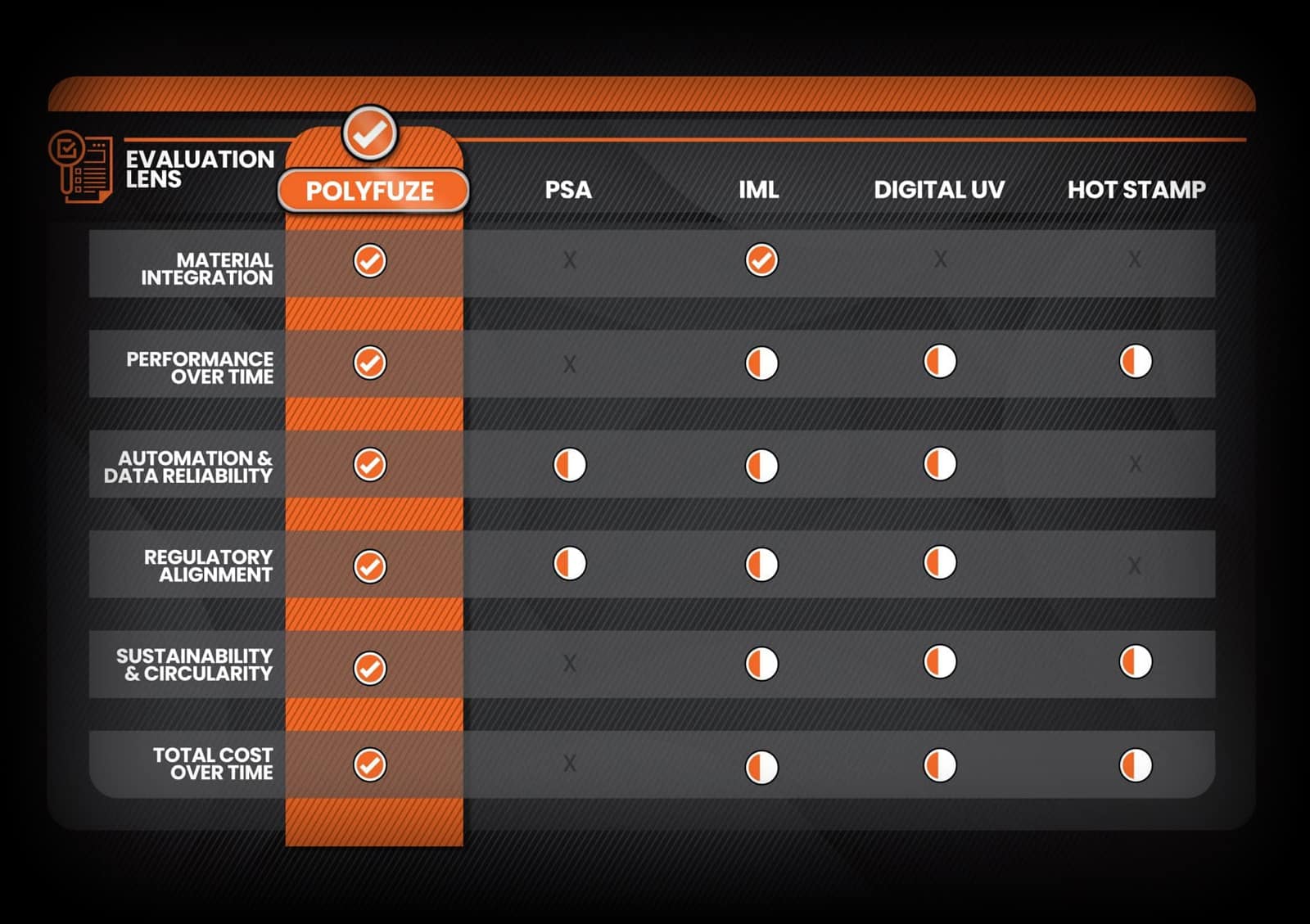
Labeling Systems Comparison
The Choice Depends on What You Value in a Labeling System
A structured process for validating, implementing, and scaling mono-material labeling in real-world production environments.
Decision at the Point of Purchase vs. Performance Over Time
Most labeling technologies are evaluated at the moment of application. Upfront cost, visual appearance, and ease of installation often drive the initial decision. But in systems that operate over years, not days, labeling becomes part of a much larger equation.
Durability affects replacement cycles.
Readability affects automation and traceability.
Hidden costs such as loss mitigation and slow downs.
Material compatibility affects recyclability and regulatory alignment.
Over time, these factors influence labor requirements, operational consistency, and the reliability of the data systems built on top of them.
Some labeling technologies appear inexpensive at first, but introduce ongoing maintenance and replacement. Others require a higher upfront investment but are designed to perform for the life of the product.
Polyfuze is often the most expensive solution at the point of purchase. It is also designed to eliminate many of the recurring costs associated with surface-applied labels — replacement labor, degraded barcodes, adhesive failure, and relabeling cycles.
In the end, the choice is not simply about labeling technology. It reflects what the system is designed to optimize.
Lowest initial price.
Or consistent performance over time. Both are valid decisions, they simply prioritize different forms of value.
Why material integration outperforms surface attachment. When you compare labels the way systems actually use them, mono material labeling pulls ahead fast. Pressure-sensitive, in-mold, and hot-stamp labels cling to the surface and slowly fall apart under heat, abrasion, and regulation, while mono-material labeling becomes part of the plastic itself.
Easy To Apply - Polyfuze Labeling Using the VERSAFLEX System
Easy To Apply Polyfuze Labels - Using Standard Hot Stamp / Heat Transfer Equipment
Free SEM Analysis Data For Fusion Labeling!
Complete the form below and we will send you the full SEM Analysis data to help you learn why Fusion Labeling can help solve your polyolefin labeling problems.