


Case Study.
Engineered To Glow When
Everything Else Fails
A permanent photoluminescent identity system designed to maintain visibility, durability, and safety performance for the 15+ year lifecycle of autonomous vehicles.
Executive Summary
Designing Identity for Safety Systems That Must Perform for 15+ Years
Autonomous vehicles introduce a new kind of safety challenge. In a traditional vehicle, drivers instinctively understand door controls, emergency mechanisms, and escape paths. In an autonomous passenger environment, those assumptions disappear. Safety systems must remain intuitive, visible, and dependable, even during complete power loss.
For the Cruise autonomous vehicle program, a collaboration between General Motors and Honda, one critical requirement emerged: How do passengers locate an emergency door release in total darkness if vehicle power fails? The answer required more than a graphic. It required a permanent identity system engineered to survive the full operational life of the vehicle.
1. Industry / Context
The Cruise autonomous vehicle platform was designed around next-generation mobility, passenger safety, and long-term operational reliability. Interior systems needed to meet demanding automotive durability standards while supporting modern sustainability requirements, including compatibility with recyclable polypropylene components and IMDS reporting standards.
Within this environment, emergency release identification became a mission-critical safety component. Not simply a decorative or instructional label.
The graphics needed to:
- Remain permanently attached for the life of the vehicle
- Maintain photoluminescent performance over time
- Survive abrasion, handling, cleaning, and environmental exposure
- Integrate with polypropylene interior components
- Remain highly visible during complete electrical failure
- Perform consistently for a 15+ year vehicle lifecycle
Most importantly, the glow performance itself had to remain dependable over time. A glowing safety graphic that fades, peels, scratches, or delaminates after years of use creates operational and safety risk precisely when it is needed most.
2. Operational Challenge
Traditional “glowing” automotive graphics were not designed for this type of long-duration safety requirement.
The Cruise program required a photoluminescent emergency release graphic capable of functioning as part of the vehicle’s safety infrastructure, not as a temporary applied marking.
This created several engineering challenges simultaneously:
- Maintaining photoluminescent visibility over extended operational life
- Preventing edge lift or delamination on polypropylene surfaces
- Ensuring readability after years of cleaning and passenger interaction
- Withstanding wear without degradation of the glowing layer
- Integrating into a recyclable mono-material interior strategy
- Delivering consistent performance for more than a decade
In autonomous vehicle environments, the failure of a safety graphic is not cosmetic. It becomes a system reliability issue.
3. Why Traditional Graphics Failed
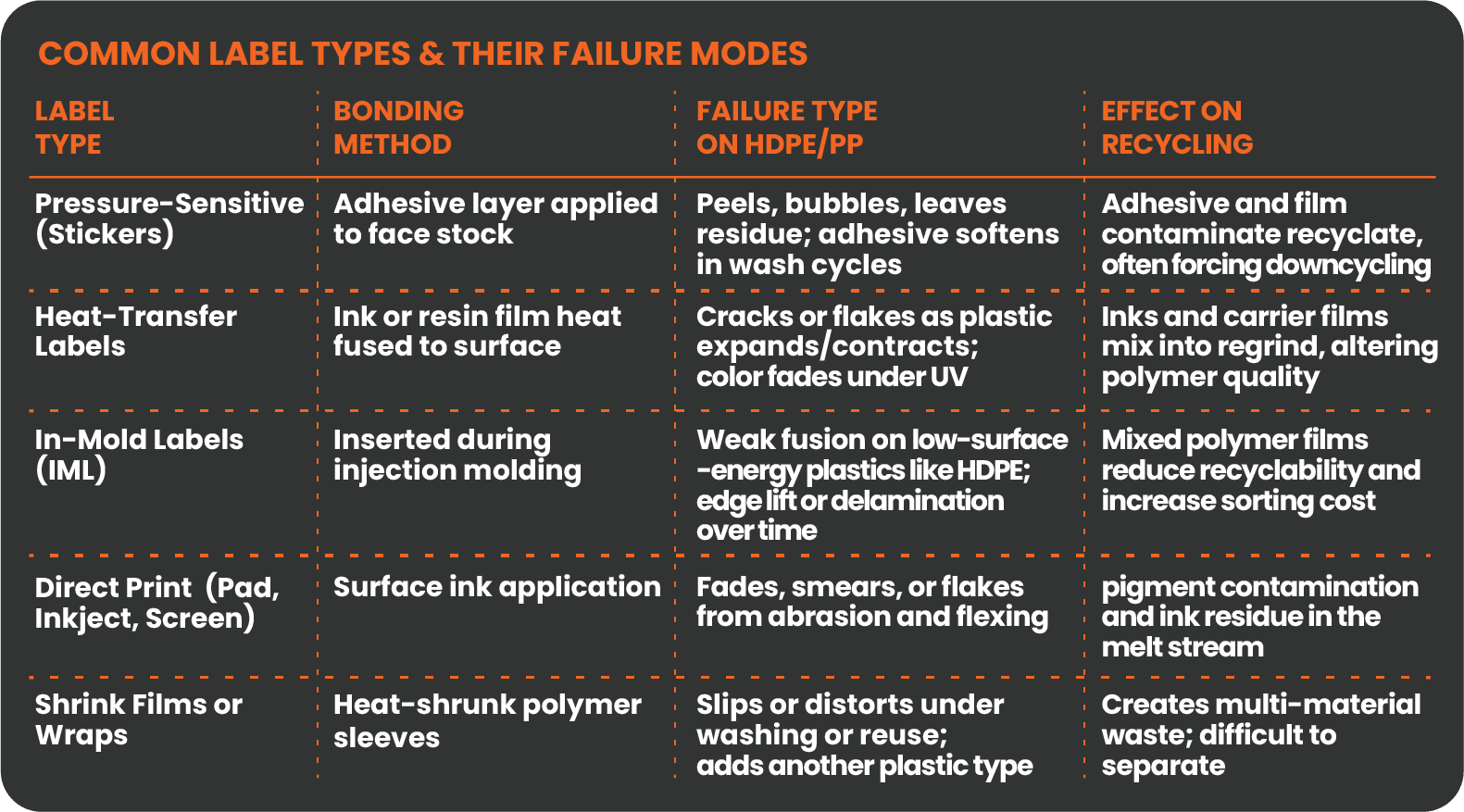
Conventional graphics technologies rely on adhesives, coatings, inks, or surface-level attachment methods. Over time, these systems are vulnerable to:
- Peeling
- Edge lift
- Abrasion
- UV degradation
- Cleaning chemical exposure
- Surface wear
- Loss of luminance performance
- Delamination from low surface energy plastics like polypropylene
For most vehicle graphics, gradual degradation may be acceptable. For an emergency safety identifier designed to guide passengers during a power outage, it is not. The challenge was not simply creating a glowing graphic. The challenge was ensuring the graphic would still glow and remain fully intact, after 15 years of operational use.
That performance requirement eliminated nearly every conventional approach.
4. The Polyfuze Solution
Polyfuze engineered a custom photoluminescent mono material graphic specifically for the Cruise autonomous vehicle interior environment. Rather than relying on adhesives or surface coatings, the Polyfuze process molecularly fused the photoluminescent graphic directly into the polypropylene substrate itself.
This approach created a permanent identity layer engineered for lifecycle durability.
The solution delivered three critical performance advantages:
- Permanent Fusion to Polypropylene
The graphic became part of the component itself rather than an applied surface layer, preventing peeling, lifting, or separation over time. - Long-Term Photoluminescent Reliability
The glowing safety identifier maintained visibility during power-loss scenarios while protecting the integrity of the photoluminescent layer from operational wear. - Sustainability Alignment
Because the graphic system was compatible with polypropylene substrates, the solution supported automotive recyclability and IMDS material compliance objectives.
The result was not simply a durable label. It was a permanent safety identification system engineered directly into the material structure of the vehicle interior.
Industry Leaders Choose The Polyfuze Advantage































5. Operational Impact
Following rigorous automotive durability evaluation and performance testing, the Polyfuze photoluminescent fusion graphic was approved for use within the autonomous vehicle program.
The implementation delivered several operational benefits:
- Permanent emergency release visibility
- Reliable glow performance during power outages
- Elimination of adhesive failure risk
- Improved long-term appearance consistency
- Compatibility with polypropylene interior systems
- Support for sustainability and recyclability initiatives
- Reduced long-term maintenance and replacement concerns
Most importantly, the solution met a requirement no conventional graphics system could reliably achieve: Dependable photoluminescent performance over a 15+ year vehicle lifecycle.
6. Strategic Insight
As vehicles become increasingly autonomous, connected, and software-driven, physical identity systems become more, not less important.
Digital systems still depend on physical human interaction during emergency scenarios.
A passenger escaping a disabled autonomous vehicle during a power outage is not interacting with software. They are relying on a physical guidance system that must still function years later under real-world conditions.
This project demonstrates a broader shift occurring across transportation and industrial systems: Performance over time is becoming the defining requirement for identity infrastructure.
Not simply visibility on day one. Not compliance during launch testing. But dependable functionality after years of operational exposure.
In critical environments, permanence is no longer cosmetic. It is part of system reliability.
About Polyfuze
Polyfuze’s revolutionary Mono Material labeling technology represents a major breakthrough in sustainable industrial packaging. Unlike traditional labels that use incompatible materials and adhesives, Polyfuze permanently fuses branding, barcodes, RFID and compliance information directly into the surface of polyolefin products like HDPE and PP.
The result is a label that never peels, fades, or contaminates the recycling stream—ensuring full compatibility with closed-loop and circular economy goals.
Engineered for demanding use cases such as pallets, totes, crates, and IBCs, Polyfuze empowers OEMs and end users to meet rising sustainability standards without sacrificing durability, traceability, or performance. As the only labeling solution of its kind, Polyfuze is redefining what’s possible in recyclable, reusable packaging.
Established in 1983, we bring over four decades of expertise in plastics labeling and graphics. Our founder’s entrepreneurial spirit remains a driving force in our culture, fueling a commitment to innovation that begins with listening closely to our customers.
Tell us about your application and we’ll help you determine if Polyfuze is the right fit.
We’ll review:
- Material compatibility
- Labeling method
- Volume and scale
- Implementation approach