Case Study.
When the Label Becomes the Problem: How Polyfuze Solved Identification for Reusable Plastics

Reusable Packaging Isn’t Failing. The Labels Are. 

In the world of reusable packaging—pallets, totes, crates, bins, it’s not the plastic body that fails first.

It’s the label. Scan errors. Scratched barcodes. Stickers peeling off in automated lines. Identifiers turning into smeared ghosts after their tenth wash cycle.

For years, the packaging industry has treated these failures as inevitable. Annoying, yes. Operationally frustrating, sure. But it’s unavoidable. Until, as one supply chain director put it, “We realized our labeling system was costing more than the containers themselves.”

Nowhere was this mismatch clearer than inside one of the largest automotive supply chains in North America. That’s the moment Polyfuze entered the story.
The Challenge – A Durable Dependable Label

In a high-velocity automotive supply chain, reusable plastic containers were designed to last for years. The labels on them barely lasted months.

“Automation doesn’t tolerate ambiguity,” their robotics integrator said. “If the barcode is dirty, missing, angled wrong—everything stops.”

– Quote from Packaging Design Partner
The Problem: Constant Label Failure Disrupts the Supply Chain

The client, a large US-based automotive company, transports millions of auto parts around the world operating a billion-dollar supply chain. They partnered with a packaging design firm to build durable, reusable custom industrial packaging for efficient, cost-effective transport. To their credit, they designed a re-usable, sustainable, and efficient system.  

Their supply chain is the backbone of delivering manufacturing excellence – a competitive advantage. They move hundreds of thousands of RPCs a week. Small failures quickly ripple through the supply chain like an accident at rush hour. 

These RPCs are power washed after each delivery cycle. The labels were peeling off after 2-3 power washes. Each RPC has six labels. These labels are the identity of the RPC. They contain all the information required for the supply chain to operate; part details, destination, track and trace, assigned sequence, return location, return path. The label is a critical failure point no one addressed when designing the system. Every missing barcode becomes a missing car part. 

The law of unintended consequences showed up quickly. Multiply a tiny failure by millions of movements and you get system turbulence.

For our customer, the unexpected labor and down-time impact was not sustainable. The numbers quickly escalated.

Six labels per unit. Five thousand units a week. Thirty thousand labels to remove and reapply. Assume five minutes per unit. Twenty-five thousand minutes a week. A labor rate of $22/hour. An extra $5500/week in labor costs for one location.

A $.05 label took down a hundred-million-dollar supply chain. In one week, their team was spending the equivalent of +15 full workdays relabeling assets, for a system designed to remove labor.

Let’s not swipe past the environmental drag. This customer is very environmentally conscientious. Sustainability is a high-ranking corporate responsibility objective. The decision to go with more expensive reusable packaging was partly driven by sustainability, and now, due to label failure, they are sending thirty thousand labels a week to the landfill.

A circular system was leaking at the label layer.

Every time a label fails, the supply chain eats the cost: 

The Opportunity – Hidden Inside The Problem

The Automotive Case — “When a 5¢ Label Breaks a $100M Supply Chain”

Here’s the irony: Reusable plastic assets already solve circularity, durability, and total cost of ownership challenges. What’s missing is A long-life identification system that matches the RPCs lifespan. Why do traditional labels fail?

Plastic is a paradox for labels. Plastic is designed for low surface energy (LSE). LSE holds weak molecular attraction, making it inherently difficult for adhesives and coatings to stick. Low surface energy equals low adhesion. Low adhesion means label failure. Label failure is supply chain death by a thousand labels. 

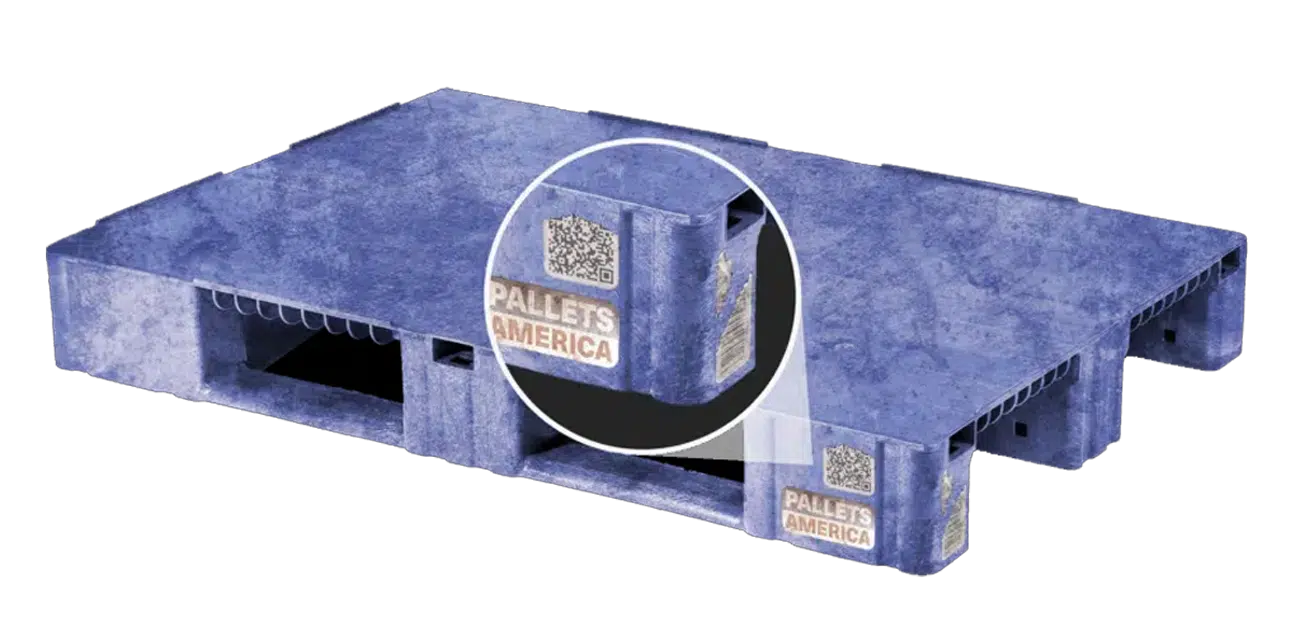
The Polyfuze Breakthrough: Labels Made of the Same Plastic as the RPC. The Polyfuze mono-material labeling system uses molecular fusion technology where the label becomes part of the polymer structure. No adhesives. No secondary films. No laminate. Just fusion.  

The customer initially believed traditional PSA labels would perform adequately. The label is an afterthought to most supply chain managers and packaging designers. Add to the decision process a buyer looking at a 5-cent label versus a 25-cent label with no context, and you end up with catastrophic label failure costing millions of dollars.

We worked with the customer, package designer, and RPC manufacturers to apply polyfuze mono material labels. Eliminating millions of economic and environmental waste.

When we heard the label becomes part of the plastic, we stopped calling it a label.

– Packaging Engineer

“6 labels / RPC” Every label carries part, route, and return data.

“30,000 labels / week” Removed and reapplied at one location.

“$9,000 / week in extra labor” Just to keep the system running.

“1 bad barcode = 1 stalled line” Automation doesn’t tolerate ambiguity.

Our equipment works exactly as designed. It’s the label that creates the exception.
Every bad scan becomes manual intervention.”

– Manufacturing Engineer

Results: An Optimized Supply Chain 

Molecular Fusion

Engineered For The Real World

Mono-Material By Design

Environmental Impact: When a Label Becomes a Climate Variable

In most discussions about reusable packaging, environmental impact is framed at the container level: resin choice, wall thickness, durability, reuse cycles. Labels rarely enter the conversation. They are assumed to be negligible, too small to matter, too inexpensive to measure. 

This case challenges that assumption. 

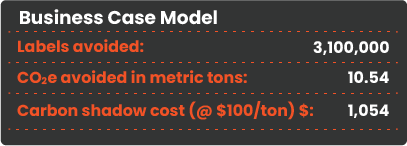
Over a ten-year lifecycle, the shift to Polyfuze mono-material labeling prevented approximately 3.1 million traditional pressure-sensitive labels from being produced, applied, removed, and discarded. Individually insignificant, these labels collectively represented a measurable environmental burden—one that existed entirely outside the original sustainability intent of the reusable packaging system. 

The Environmental Reality of Traditional Labels 

Conventional labels used on reusable plastic containers are typically composite products: paper or plastic facestock, pressure-sensitive adhesives, release liners, inks, and coatings. Once applied and exposed to wash cycles, abrasion, and heat, these materials are no longer recyclable in practice. Adhesives contaminate wash streams, interfere with regrind quality, and introduce additional labor at recycling facilities. 

As a result, recyclers often face an economic decision rather than a technical one: invest time and labor to remove labels or reject the container altogether. In many cases, rejection wins. 

This dynamic creates an environmental paradox. A container designed explicitly to support circularity can become landfill-bound because of a label that was never designed for reuse. 


Quantifying Carbon Impact: A Conservative Model 

To evaluate the climate implications of avoiding 3.1 million labels, we modeled the cradle-to-grave carbon emissions associated with traditional label production and disposal. The goal was not to maximize impact claims, but to establish a conservative, defensible baseline suitable for ESG and regulatory reporting. 

A Design Decision With Climate Consequences 

This case underscores a broader truth about sustainable systems: environmental performance is often determined by the weakest component, not the strongest one. 

Reusable plastic containers already represent a significant step toward circularity. But without durable, compatible identification, that promise erodes—quietly, expensively, and at scale. 

By removing labels from the waste stream entirely and aligning identification with material chemistry, Polyfuze transforms a chronic operational failure into a measurable environmental gain. 

In an era where sustainability claims are increasingly scrutinized, this matters. The most credible climate improvements are the ones that also make systems work better. 

Here, operational efficiency and environmental responsibility are not in conflict. They are the same decision. 

Results: An Optimized Supply Chain 

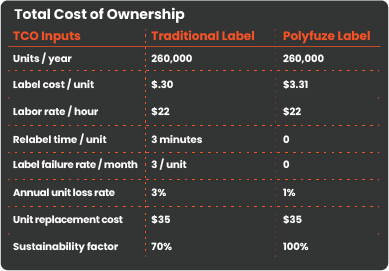
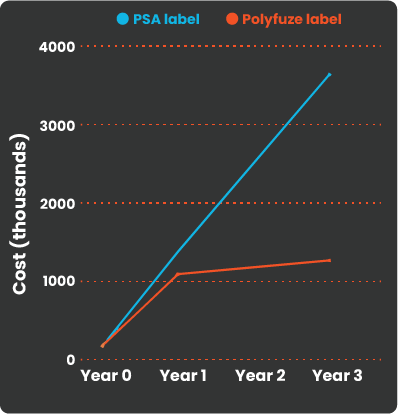
Thinking through the investment our customer has poured into optimizing their supply chain is captivating. Millions spent on automation, track and trace systems, package design, compliance, and transport systems. A hundred-million-dollar supply chain that can come to an abrupt stop due to a 5-cent label failure. Not only does a polyfuze mono-material label address supply chain efficiency. The total cost of ownership model is 2better than a traditional label or 1/2 the cost, but the value is more impactful in the supply chain. Less disruption. High predictability. More efficient. 

Economics

The TCO model is an absolute win for mono-material labeling. Now let’s consider the sustainability impact of traditional labels. Over a three-year period, the traditional labels path would add approximately 3 million labels to the environment. The numbers escalate quickly when replacing all labels on each RPC every two months for three years. This is not a circular economy-friendly solution. 

“We stopped thinking about labels entirely. And that’s the point.” – Automation Lead

**Note** This analysis accounts for direct costs only. It does not include the far more damaging indirect costs, like production stoppages, compliance failures, or lost traceability, that occur when labels fail in the field.

Hard Lessons Learned, The Hard Way

In a decade defined by automation, sustainability-driven regulation, and end-to-end data visibility, reusable packaging has never been more essential. The whole system depends on the simple label. The holder of all critical data. Modern systems dependent on 1935 technology.  A real problem. 

As our automotive customer quickly discovered, hundred plus million-dollar supply chains can be broken by a 5-cent label. What held them back wasn’t durability. It wasn’t simply design. It wasn’t even cost. It was the wrong technology. 

In a world where automation depends on perfect data, the label can no longer be the weak link. 

Polyfuze didn’t just fix the label problem. We removed the weakness inside the system and replaced it with something permanent, elegant, and inevitable. Dependable. Efficient. 

We restored trust in the system that depends on them. 

In the reusable economy, that’s not an upgrade. It’s the missing layer of infrastructure. 

The Takeaway: 3-Year Total Cost of Ownership

About Polyfuze

Polyfuze’s revolutionary Mono Material labeling technology represents a major breakthrough in sustainable industrial packaging. Unlike traditional labels that use incompatible materials and adhesives, Polyfuze permanently fuses branding, barcodes, RFID and compliance information directly into the surface of polyolefin products like HDPE and PP.

The result is a label that never peels, fades, or contaminates the recycling stream—ensuring full compatibility with closed-loop and circular economy goals.

Engineered for demanding use cases such as pallets, totes, crates, and IBCs, Polyfuze empowers OEMs and end users to meet rising sustainability standards without sacrificing durability, traceability, or performance. As the only labeling solution of its kind, Polyfuze is redefining what’s possible in recyclable, reusable packaging.

Established in 1983, we bring over four decades of expertise in plastics labeling and graphics. Our founder’s entrepreneurial spirit remains a driving force in our culture, fueling a commitment to innovation that begins with listening closely to our customers.

Tell us about your application and we’ll help you determine if Polyfuze is the right fit.

We’ll review:

  • Material compatibility
  • Labeling method
  • Volume and scale
  • Implementation approach

Easy To Apply - Polyfuze Labeling Using the VERSAFLEX System

Easy To Apply Polyfuze Labels - Using Standard Hot Stamp / Heat Transfer Equipment

Free SEM Analysis Data For Fusion Labeling!

Complete the form below and we will send you the full SEM Analysis data to help you learn why Fusion Labeling can help solve your polyolefin labeling problems.